
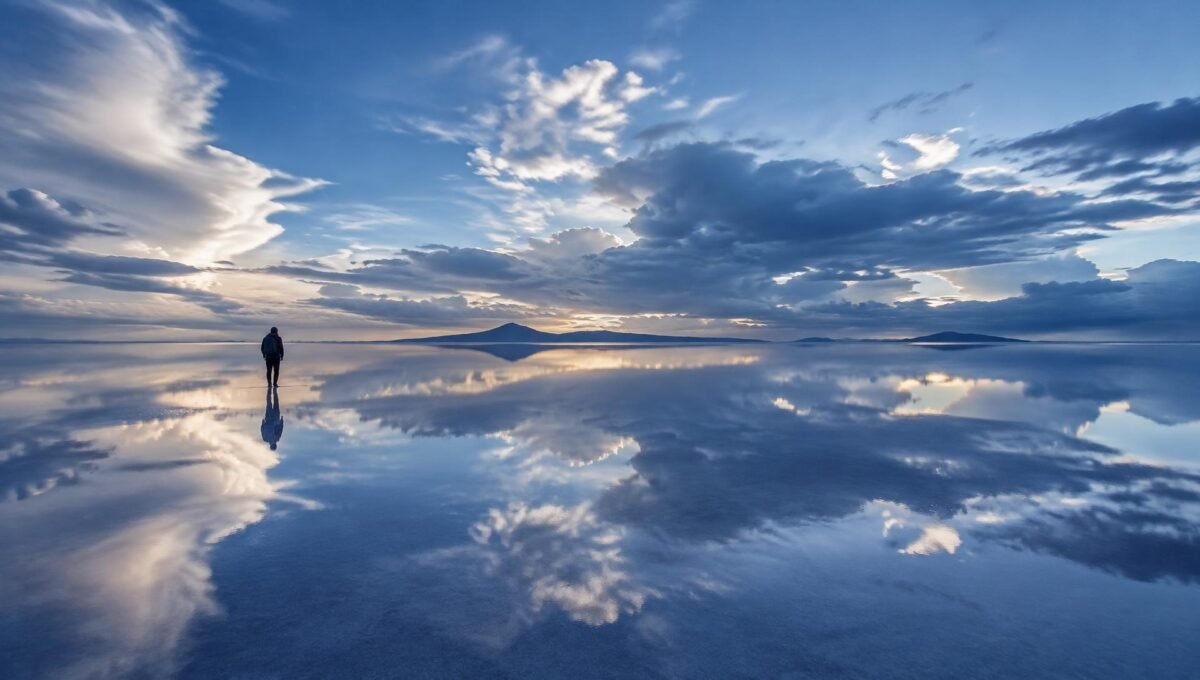
Every year, thousands of travelers arrive in Uyuni hoping to stand on the sky. Some get exactly that: a flat sheet of water a few centimeters deep, no wind, and clouds reflected so perfectly that the horizon disappears. Others arrive in the right month and still find a dry, white crust, or a lake so deep and choppy that their jeep cannot leave the shore. The difference is almost never luck alone. It comes down to understanding how the salar de uyuni mirror effect forms and planning around it.
We grew up in Bolivia, and the question we hear most from friends and readers is simple: “When should I go to see the mirror?” This guide answers it properly. You will find what physically creates the reflection, a month-by-month table with mirror odds, crowds, road access and temperatures, the best hours of the day, the things you cannot do when the water is deep, practical photography and gear tips, and a clear recommendation on which tour to book.
If you are still deciding between seasons, read this alongside our guide to the dry season on the salar, because the best month for you depends on what you want to see.
Quick answer: The Salar de Uyuni mirror effect is most reliable from mid-January to mid-March, with February usually the peak. December and April can give partial mirrors, and late November occasionally does. You need a thin layer of water (a few centimeters), calm wind and some clear sky, so early morning and sunset are the best hours. Build in 2-3 flexible days and ask operators about current water levels before you book.
What Actually Creates the Mirror Effect
The Salar de Uyuni covers roughly 10,500 km² at about 3,650 m above sea level in the Potosí Department of southwestern Bolivia. It is one of the flattest places on Earth: across its whole surface, the height varies by less than a meter. That extreme flatness is the secret. When rain falls on the salt crust, it does not drain away into valleys or rivers. It spreads out into a thin, even sheet. If the air is still, that sheet behaves like a giant mirror.
A thin layer of water
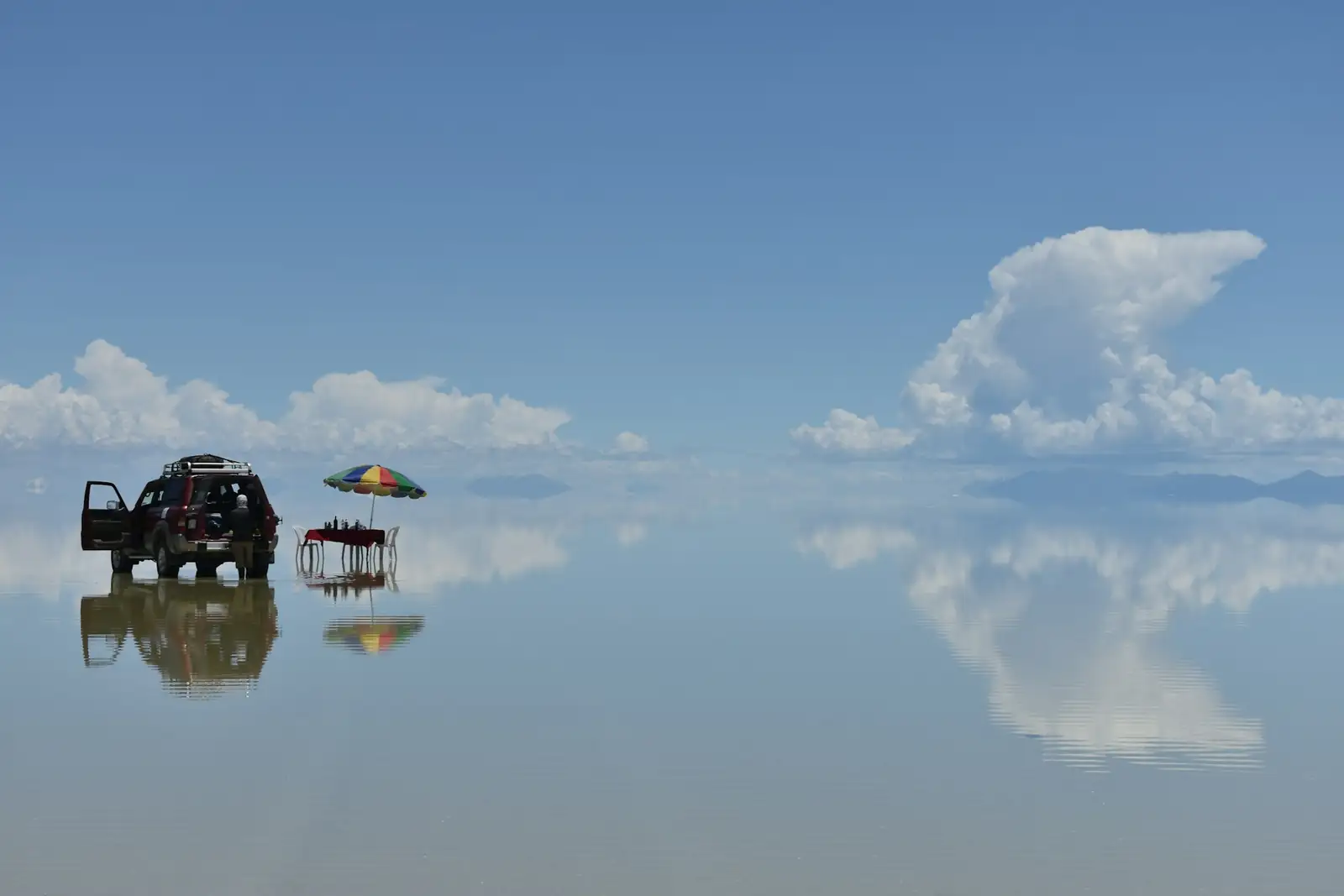
The ideal mirror forms when the water is shallow, usually a few centimeters deep, roughly up to your ankle. At that depth the surface sits perfectly level over the salt, and you can walk, jump and pose without soaking your knees. When the water rises much higher, two problems appear. First, vehicles struggle and drivers avoid the deeper zones, so you may only reach the edges of the salar. Second, deeper water is more easily disturbed by wind, which breaks the reflection into ripples.
Too little water is also a problem. When the salar is only damp, you get a glossy sheen and scattered puddles, which can still make nice photos but will not give the full “walking on the sky” effect. This is why the shoulder months (late November, December and April) are hit or miss.
Calm wind
Wind is the most underrated factor. Even a light breeze creates small ripples that blur the reflection. On the altiplano, mornings tend to be calmer, and wind often picks up from late morning into the afternoon. Many evenings calm down again around sunset. That pattern is why experienced drivers schedule mirror stops for sunrise and sunset whenever they can.
Rain and clear skies
The rainy season on the altiplano runs roughly from December to April. Rain often arrives as afternoon or evening storms, followed by clearer mornings. You need the rain to fill the salar, but you also need breaks in the clouds for the reflection to look dramatic. A completely overcast sky still reflects, but it looks gray and flat. The best mirror days usually come with scattered white clouds and patches of deep blue sky, which is common in the wet season at this altitude.
Where on the salar the mirror forms
Water does not spread evenly. Some zones, especially areas closer to the eastern side near Colchani (about 20 km north of Uyuni town), tend to hold a shallow, reachable layer. Operators know which sectors are holding water in any given week and adjust their routes. This is why a local guide matters more in the wet season than in the dry season: the route changes almost daily. For the basics on where the salar sits and how the town of Uyuni connects to it, see our overview of where the Salar de Uyuni is.
Month-by-Month Guide to the Mirror Effect
The table below summarizes typical conditions. It is a guide, not a guarantee. Rainfall changes from year to year, and in a dry year the mirror can be patchy even in February, while in a wet year parts of the salar can stay flooded into April. Temperatures are approximate for the salar area.
| Month | Mirror odds | Crowds | Road and route access | Temperature (day / night) |
|---|---|---|---|---|
| November | Low: first rains, occasional wet patches late in the month | Low to moderate | Generally full access, Incahuasi Island usually open | ≈ 15-20 °C / around 0 °C |
| December | Low to medium: improves toward the end of the month | High around Christmas and New Year | Mostly open, some sectors start to flood late in the month | ≈ 15-20 °C / around 0 °C |
| January | High: reliable standing water in many years | High (South American summer holidays) | Incahuasi often unreachable, central salar limited, some 3-day routes adjusted | ≈ 15-20 °C / around 0 °C |
| February | Highest in most years | Very high around Carnival and Lunar New Year | Same limits as January, heavy rain can cancel some departures | ≈ 15-20 °C / around 0 °C |
| March | High: water lingers, rain eases | Moderate, easing through the month | Incahuasi still often closed, access slowly improves | ≈ 15-20 °C / around 0 °C |
| April | Medium to low: patchy mirror, often early in the month | Low to moderate (busier around Easter) | Dry sectors re-open, more of the salar reachable | ≈ 14-18 °C / below 0 °C |
| May | Very low: occasional leftover puddles only | Moderate | Full access, all classic stops open | ≈ 13-17 °C / well below 0 °C |
November: the first hints
November is still mostly a dry-season experience. The salar is white, hard and fully accessible, and Incahuasi Island is usually reachable. Late in the month, the first storms can leave thin wet patches that reflect the sky. Do not plan a trip around the mirror in November, but if you get one, treat it as a bonus.
December: rising odds, rising crowds
In December, rain becomes more regular and the first real mirror zones appear, often in the second half of the month. Christmas and New Year bring holiday travelers from Bolivia, neighboring countries and further afield, so hotels and private tours fill up. If you travel between December 20 and January 5, book early. December is a good month if you want a mix: dry areas for perspective photos and some wet areas for reflections.
January: reliable water in most years
By January, the salar usually holds standing water across large areas. This is when the classic mirror photos happen. It is also the month when access starts to shrink. Drivers avoid deep or soft zones, and Incahuasi Island, about 80 km from the eastern shore, is often off the itinerary. Expect summer holiday crowds, especially from South America.
February: the peak, with caveats
February is usually the most reliable month for the mirror, but it is also the wettest. Heavy afternoon storms can cancel tours or shorten them, and some days the water is simply too deep. February also brings two crowd peaks: Carnival (Oruro’s famous Carnival and celebrations across Bolivia) and Lunar New Year, which is popular with travelers from East Asia. In 2027, both fall in the first half of February, so if you are flexible, the second half of the month is usually calmer.
March: our favorite balance
March is often the sweet spot. The heaviest rains are usually over, but water lingers on the salar. Skies tend to be clearer, which means better reflections and better stargazing. Crowds ease after Carnival. If we had to choose one month for a first-time visitor whose main goal is the mirror, we would choose late February to mid-March.
April: a mixed bag
April is a transition month. In a wet year, you can still find a mirror in early April, and more of the salar becomes accessible as it dries. In a dry year, the mirror may already be gone. The upside is that you may see both faces of the salar in one trip. Easter week can bring Bolivian travelers to Uyuni, so check dates.
May: the dry season returns
From May onward, the salar is almost always dry and white, with the famous hexagonal salt patterns visible. You may find a few leftover puddles in early May, but no reliable mirror. If you want both the mirror and the hexagons, you need either two trips or a well-timed April visit with some luck. For everything about the dry months, see our guide to the Salar de Uyuni dry season.
🗺️ BOOK YOUR SALAR TOUR
See the mirror with local licensed guides
A full-day excursion from Uyuni is the simplest way to reach the mirror zones, with drivers who know which sectors are holding water this week.
Check day tour availability →✓ Free cancellation on most tours · ✓ Instant confirmation · ✓ Local operators
Best Time of Day to See the Mirror
Picking the right month gets you onto a wet salar. Picking the right hour gets you the reflection. In the rainy season, the day roughly runs from sunrise around 6:00-6:30 to sunset around 19:00, and the light and wind change a lot across those hours.
Sunrise: the calmest water
Sunrise tours leave Uyuni in the dark, often around 4:00-4:30, to reach the mirror zones before first light. The reward is usually the calmest water of the day and soft pink and orange colors reflected below the horizon. It is cold, often near freezing, so bring warm layers even in January. If you only book one special tour, sunrise is the best bet for a still mirror.
Midday: bright, but often windy
Standard day tours reach the mirror around midday. The sky is often deep blue with big white clouds, which looks great in reflection, but the sun is harsh and wind can ruin the surface. Midday is still the time for most of the fun perspective photos, and many day tours combine this with lunch and a sunset stop.
Sunset: the classic finale
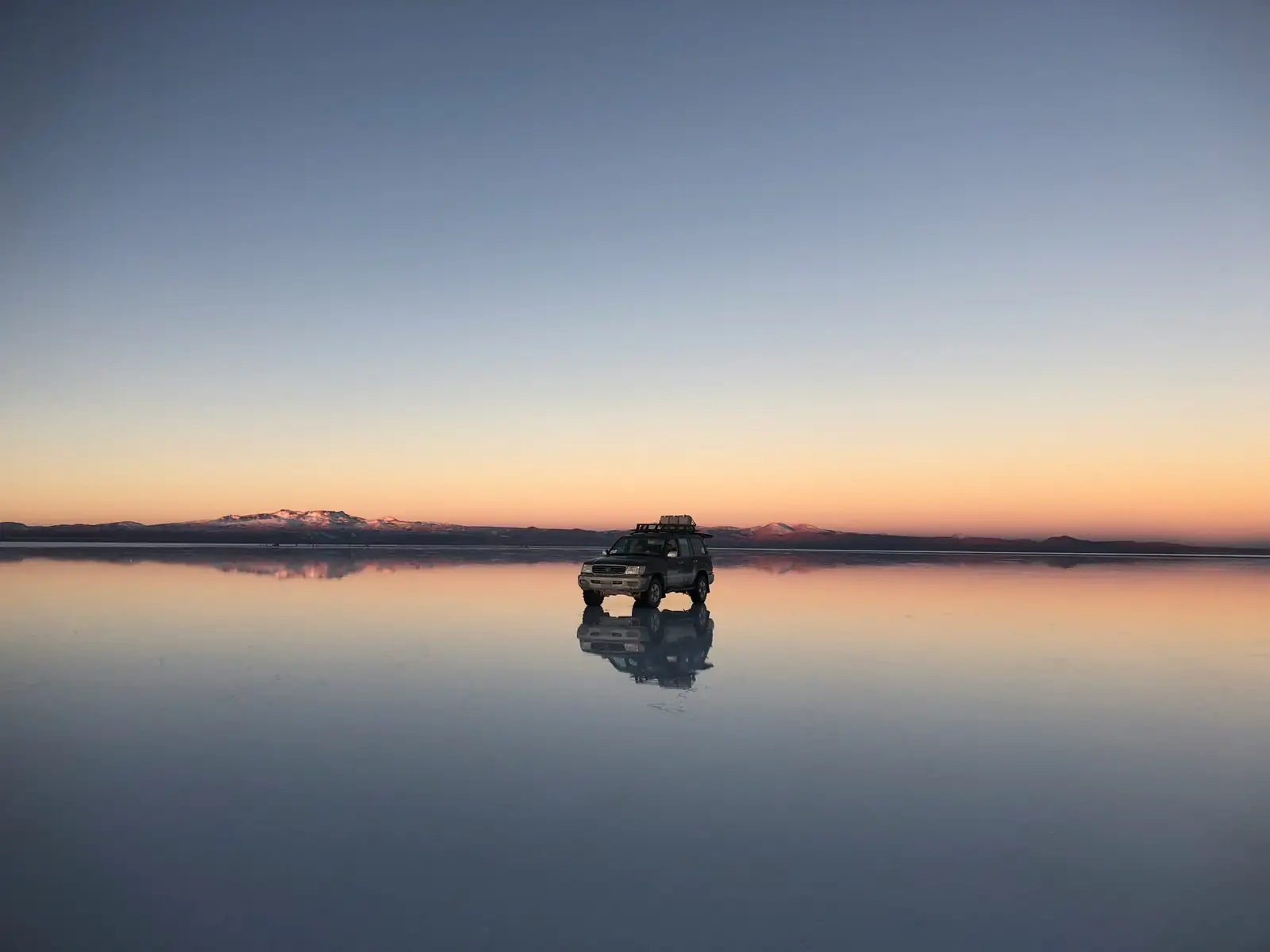
Most full-day excursions end with sunset on the water, and for good reason. The wind often drops in the late afternoon, and the colors can be extraordinary. You get silhouettes, doubled skies and the most popular photos of the trip. Sunset is also when storms can roll in, so be ready for the plan to change.
Stargazing on the mirror
On a clear, moonless, windless night, the stars reflect in the water and you feel like you are floating in space. This is one of the most special experiences in Bolivia, but it depends on three things at once: water, no wind and no clouds. Rainy season nights are often cloudy, so stargazing tours are frequently rescheduled or cancelled. Check the moon calendar (new moon is best) and keep a spare night. It gets very cold after dark, so dress for below-freezing temperatures.
How to Maximize Your Chances of Seeing the Mirror
No one can promise you a mirror. Anyone who does is selling, not informing. But you can stack the odds strongly in your favor.
Keep your dates flexible
The single most useful thing you can do is give yourself 2-3 days in Uyuni rather than one. If the first day is windy or stormy, you can try again. Many travelers squeeze Uyuni into a tight Bolivia itinerary and arrive on the overnight bus, take a tour that day and leave that night. In the rainy season, that is the most common way to miss the mirror. Plan for a buffer day, and if you are coming from La Paz, read our guide on how to get to Uyuni from La Paz to choose between the flight (about 1 hour), the overnight bus (about 10-12 hours) and the train from Oruro (about 7 hours).
Ask operators about current water levels
Before you book, ask the tour company two direct questions: “How deep is the water right now?” and “Which sectors are you reaching this week?” Good operators will give honest answers, including “there is very little water right now” or “it is too deep to go far today.” If you book through a platform, you can still message the local operator after booking. You are also welcome to send us a question through our WhatsApp contact page before you commit.
Consider a private tour
Shared tours follow a fixed schedule built around the average traveler. A private tour lets you leave earlier, stay longer on the water, chase calmer areas and return to the mirror when the wind drops. For photographers and couples, the extra cost is often worth it during mirror season, because time on the water at the right hour is what you are really paying for.
Stay close to the salar
Sleeping in Uyuni town or in one of the salt hotels near Colchani cuts travel time before sunrise and after sunset. Some salt hotels sit right at the edge of the salar, which makes early starts easier. Rooms around Christmas, New Year and Carnival sell out early, so search well ahead on Booking.com and compare options in our guide to salt hotels near Salar de Uyuni.
Watch the weather, but not too closely
Forecasts for the altiplano are useful for broad patterns (a stormy week versus a clearer week) but less accurate hour by hour. Use them to choose which of your flexible days to book the sunrise or stargazing tour, then trust the local drivers on the day.
📸 PRIVATE MIRROR TOUR
More time on the water, on your schedule
A private excursion lets your driver chase calm water and stay for the light, which is exactly what the mirror needs.
See private tour options →✓ Private vehicle and guide · ✓ Flexible timing · ✓ Local licensed operators
What You Cannot Do When the Water Is Deep
The mirror comes with trade-offs. When the salar holds a lot of water, especially in January and February, parts of the classic itinerary may be off the table. Knowing this in advance prevents disappointment.
Incahuasi Island is often unreachable
Incahuasi Island, the rocky hill covered in giant cacti in the middle of the salar, is one of the highlights of dry-season tours. It sits roughly 80 km from the eastern shore. In the wet season, water hides soft spots in the salt crust, and getting a vehicle stuck that far out is a serious problem. Drivers often turn back or substitute a closer stop. If Incahuasi is important to you, plan a dry-season visit or confirm in writing with the operator that they are currently reaching it. The island charges its own small entrance fee in bolivianos (about 30 BOB in recent reports, but fees change), payable in cash.
The hexagonal salt patterns are hidden
The famous honeycomb shapes on the salt crust are only visible when the surface is dry. Under water, the salar is smooth and reflective. You cannot have both in the same spot at the same time.
Deep crossings and the central salar
Many crossings of the salar from one side to the other are not possible when water is high. Tours focus on the eastern sectors near Colchani, the Dakar monument, the salt flags area and the old salt hotel, plus the mirror zones the drivers can safely reach.
Multi-day routes may be adjusted
Three-day tours to the southern lagoons (Laguna Colorada, the geysers and the Eduardo Avaroa reserve) usually still run in the rainy season, but the route on the salar portion is often changed, and heavy rain can make some tracks muddy or impassable. Occasionally, tours are delayed or rerouted. This is normal, and a good operator will explain the changes upfront. For a full comparison of how itineraries differ, see our guide to 1-day vs 3-day vs 4-day tours.
Perspective photos are harder
The classic forced-perspective shots (a person standing on a bottle, a dinosaur chasing your group) work best on a dry, white, featureless surface. On water, you get reflections instead. You can still do some playful shots, but they look different. If perspective photos are a big part of your plan, look for a tour in December or April that may reach both dry and wet zones.
Mirror Season vs Dry Season at a Glance
Both seasons are worth the trip. They are simply different experiences. Use this table to decide which one matches your priorities.
| Factor | Mirror season (≈ Dec-Apr) | Dry season (≈ May-Nov) |
|---|---|---|
| Main highlight | Sky reflected on a thin sheet of water | Endless white crust and hexagonal salt patterns |
| Best months | Mid-January to mid-March | May to October |
| Incahuasi Island | Often unreachable | Usually included in tours |
| Perspective photos | Harder, reflection shots instead | Ideal, flat white background |
| Daytime temperature | Milder, ≈ 15-20 °C | Cooler, especially June-August |
| Night temperature | Around freezing | Well below freezing, coldest in June-August |
| Weather risk | Storms, cancellations, route changes | Stable, clear skies, strong sun and wind |
| Crowds | Peaks at Christmas, New Year, Carnival, Lunar New Year | Peaks in July and August |
| Stargazing | Spectacular when clear, but often cloudy | Very reliable, clear and dark skies |
| Footwear | Rubber boots essential | Sneakers or hiking shoes |
| Best tour type | Day or private tour with sunset or sunrise, flexible dates | 3-day or 4-day tour including lagoons and Incahuasi |
If you want the full Bolivian southwest (lagoons, flamingos, geysers and the island), the dry season is easier. If the mirror is the reason you are coming, choose the rainy season and accept the trade-offs. A late March or early April trip is a reasonable compromise for travelers who want a chance at both.
Photography Tips for Mirror Reflections
The mirror is easy to photograph badly and surprisingly easy to photograph well once you know a few tricks. These work with a phone as well as with a camera.
Get low
The closer your lens is to the water, the more the reflection fills the frame and the more seamless the horizon becomes. Crouch, kneel on a waterproof bag or hold your phone a few centimeters above the surface (carefully). A low angle turns a good reflection into a perfect symmetry.
Take off your polarizer
A circular polarizing filter is great in the dry season to deepen blue skies, but its main job is to cut reflections. On the mirror, that is the opposite of what you want. Remove it, or rotate it to the position that keeps the reflection strongest. Many phone camera apps and clip-on lenses include polarizing effects too, so check your settings.
Place the horizon in the middle
Normally, photographers avoid a centered horizon. On the mirror, centering it emphasizes the symmetry and creates the “floating” effect. Keep it perfectly level; even a small tilt is obvious when the image is symmetrical.
Use people and vehicles for scale
A person in a bright jacket, a jeep or a line of friends gives the reflection depth. Ask your group to stand still for a moment so their reflections are crisp. Jumping shots look great if you use a fast shutter speed or burst mode.
Shoot sunrise and sunset in the right exposure
At sunrise and sunset, expose for the bright sky so it does not wash out. The reflection will be slightly darker, which looks natural. If your camera supports it, shoot in RAW to recover shadows later. On a phone, tap on the brightest part of the sky to set exposure.
Wear rubber boots and protect your gear
Most operators lend or rent rubber boots in the rainy season (reports suggest small rental fees of around 30 BOB, but confirm with your tour). Wear them. Salt water is cold, and the crust can be sharp. For a full list of what to bring, see our guide on what to pack for Salar de Uyuni.
Safety and Protecting Your Gear from Salt Water
The salar is beautiful but unforgiving. Water, salt, altitude and sun combine in ways that catch many travelers off guard.
Salt water and electronics
Salt water is far more corrosive than rain. A splash on a camera or phone can leave salt crystals in buttons, ports and lens mounts. Keep devices in a dry bag or zip bags when not shooting, and carry a microfiber cloth. Never set a camera bag down on the wet salt. Use a waterproof backpack or keep the bag on your body. After the tour, wipe your gear with a cloth slightly dampened with fresh water, then dry it fully. Rinse tripod legs with fresh water the same day. A simple waterproof dry bag and a waterproof phone pouch are cheap insurance.
Shoes, clothes and skin
Salt dries white on clothes and can stiffen shoes. Bring a spare pair of socks and dry shoes in the vehicle. If you wear your own rubber boots, rinse them afterward. At 3,650 m, the sun is intense and the water doubles the glare, so wear sunglasses, high-SPF sunscreen, lip balm with sun protection and a hat. Sunburn on the salar happens quickly, even on cloudy days.
Altitude
Uyuni sits at roughly 3,650 m. Arriving straight from sea level, many people feel headaches, shortness of breath or poor sleep for the first day or two. Drink water, eat lightly, go slowly and avoid heavy alcohol on your first night. If you are coming from La Paz, you will already be partly acclimatized.
Storms and lightning
The salar is flat and open, and rainy season storms can bring lightning. If a storm approaches, follow your driver’s instructions and return to the vehicle. Good operators cut stops short rather than take risks with weather, and that is the behavior you want from them.
Cash, connectivity and travel insurance
Carry cash in bolivianos (BOB) for entrance fees, boots, bathrooms and snacks. ATMs are in Uyuni town but not on the salar. Bolivia’s exchange situation has been volatile in recent years, so check current rates and ask for prices in bolivianos close to your travel date. Bolivia has also seen periodic fuel shortages and road blockades, which can delay buses and tours. Travel insurance that covers trip interruption and medical care at altitude is a sensible choice for a remote area like this. For more on money and conditions, see our overview of weather, money and what to wear at the salar.
🛡️ TRAVEL INSURANCE
Rainy season plans change, be covered
SafetyWing offers flexible travel medical coverage that you can start or stop while already on the road.
Get a SafetyWing quote →✓ Buy online in minutes · ✓ Monthly subscription · ✓ Covers many countries
Which Tour Should You Book in Mirror Season?
There are three main ways to see the mirror. The right choice depends on your time, budget and how much the reflection matters compared with the rest of southwestern Bolivia. You can browse all options in our tours section.
Full-day excursion from Uyuni
This is the most popular option and the best value for most travelers. A typical day tour leaves Uyuni in the morning, visits the train cemetery, Colchani and its salt workshops, the Dakar monument, the salt flags and the old salt hotel, then heads to the mirror zones for photos and usually stays for sunset. In the rainy season, the route is adjusted to the water. It is ideal if you have 1-2 days and want the mirror as your main goal. If you have flexible dates, you can repeat it or add a sunrise tour on another day.
Private excursion
A private tour uses the same general area but on your terms. You can leave earlier, skip stops that do not interest you, stay longer at the mirror and wait for the wind to drop. It is the best choice for photographers, honeymooners, families with small children and anyone who values flexibility. Prices are higher than shared tours and vary with group size and season, so compare a few options and check what is included.
3-day tour (salar plus deserts and lagoons)
The 3-day tour covers the salar on the first day, then continues south through high deserts, colored lagoons with flamingos, geysers and hot springs. Many travelers end it in Uyuni or cross into Chile toward San Pedro de Atacama. In mirror season, the salar day is often shortened or adjusted, and Incahuasi is often skipped, but you still see the remarkable southern landscapes. Choose this if you want the full region and accept that the mirror portion may be shorter. If you want to finish in La Paz instead of returning to Uyuni, a 4-day Uyuni tour ending in La Paz is another option.
Our recommendation
If the mirror is your top priority, book a day excursion on your first day and keep a second day free for a private sunrise or sunset tour, or a repeat if conditions were poor. If you want to see the whole southwest and the mirror is a bonus, take the 3-day tour and add an extra day in Uyuni before it for a dedicated mirror excursion. Our detailed tour comparison breaks down the differences day by day.
🦩 SALAR + DESERTS + LAGOONS
The mirror and the colored lagoons in one trip
The 3-day tour adds flamingos, geysers and high deserts, with lodging and meals included along the route.
See the 3-day tour →✓ Free cancellation on most tours · ✓ Instant confirmation · ✓ Local operators
Getting to Uyuni in the Rainy Season
Most travelers reach Uyuni from La Paz. The fastest route is a domestic flight of about 1 hour, which saves a full night on the road. Flights are limited and can be affected by weather, so book early and avoid tight connections the same day. The overnight bus covers roughly 550 km in about 10-12 hours and is the budget option. The train from Oruro takes about 7 hours and runs on a limited schedule. In the rainy season, storms, roadworks or blockades can cause delays, which is one more reason to plan a buffer day. Compare international and domestic routes on Skyscanner, and see all the details in our guide on getting from La Paz to Uyuni.
✈️ FLIGHTS TO BOLIVIA
Fly closer to the mirror and save travel days
Compare fares to La Paz and Uyuni and spend your extra day on the salar, not on a bus.
Search flights →✓ Compare hundreds of airlines · ✓ Price alerts · ✓ Flexible date search
Frequently Asked Questions
What is the best month to see the Salar de Uyuni mirror effect?
February is usually the most reliable month, with mid-January to mid-March as the best overall window. March often offers a good balance of lingering water, clearer skies and smaller crowds.
Is the mirror effect guaranteed in the rainy season?
No. The mirror depends on rainfall, wind and cloud cover, which vary each year and each day. Planning 2-3 flexible days in Uyuni and asking operators about current water levels gives you the best chance.
How deep is the water during mirror season?
The best mirror forms when the water is only a few centimeters deep, roughly ankle level or less. When the water is much deeper, vehicles avoid many zones and wind ripples the surface more easily.
Can I see the mirror effect in December or April?
Often, but not reliably. December can bring the first mirror zones, especially late in the month, and April can keep some water early on. Both months may let you see dry and wet areas on the same tour.
What time of day is best for the mirror?
Sunrise usually has the calmest water, and sunset often has the best colors as the wind drops. Midday works for fun photos with blue skies, but wind is more likely to disturb the reflection.
Can I visit Incahuasi Island in the rainy season?
Often not. The island is roughly 80 km from the eastern shore, and water hides soft spots in the crust, so drivers frequently skip it from about January to March. If it matters to you, visit in the dry season or confirm with the operator before booking.
Do I need rubber boots for the mirror?
Yes. Most operators provide or rent rubber boots in the rainy season, sometimes for a small fee in bolivianos. They keep your feet dry and protect you from cold water and sharp salt.
Should I use a polarizing filter on the salar?
Not on the mirror. A polarizer reduces reflections, which weakens the effect. Remove it or rotate it to the position where the reflection is strongest, and shoot from a low angle.
Is a day tour enough to see the mirror?
A full-day excursion that stays for sunset is enough for many travelers, but weather can ruin a single day. If the mirror is your main goal, keep a second day free for a repeat, a sunrise tour or a private tour.
How cold is Salar de Uyuni in mirror season?
Days are mild, around 15-20 °C, but nights and early mornings are near or below freezing. Bring warm layers for sunrise and stargazing tours, and strong sun protection for the day.
Plan Your Mirror Trip with Confidence
The salar de uyuni mirror effect is not a matter of pure luck. Come between mid-January and mid-March, give yourself flexible days, aim for sunrise and sunset, and choose an operator who tells you honestly where the water is. Accept that Incahuasi and the hexagons belong to the dry season, protect your gear from salt, and you will leave with the reflection photos you came for.
Ready to plan? Browse our hand-picked Salar de Uyuni tours, read more about who we are on our About page, or send us your dates through the contact page and we will tell you what to expect that month. You can also start from our home page for the full guide to the salar. See you on the mirror.