
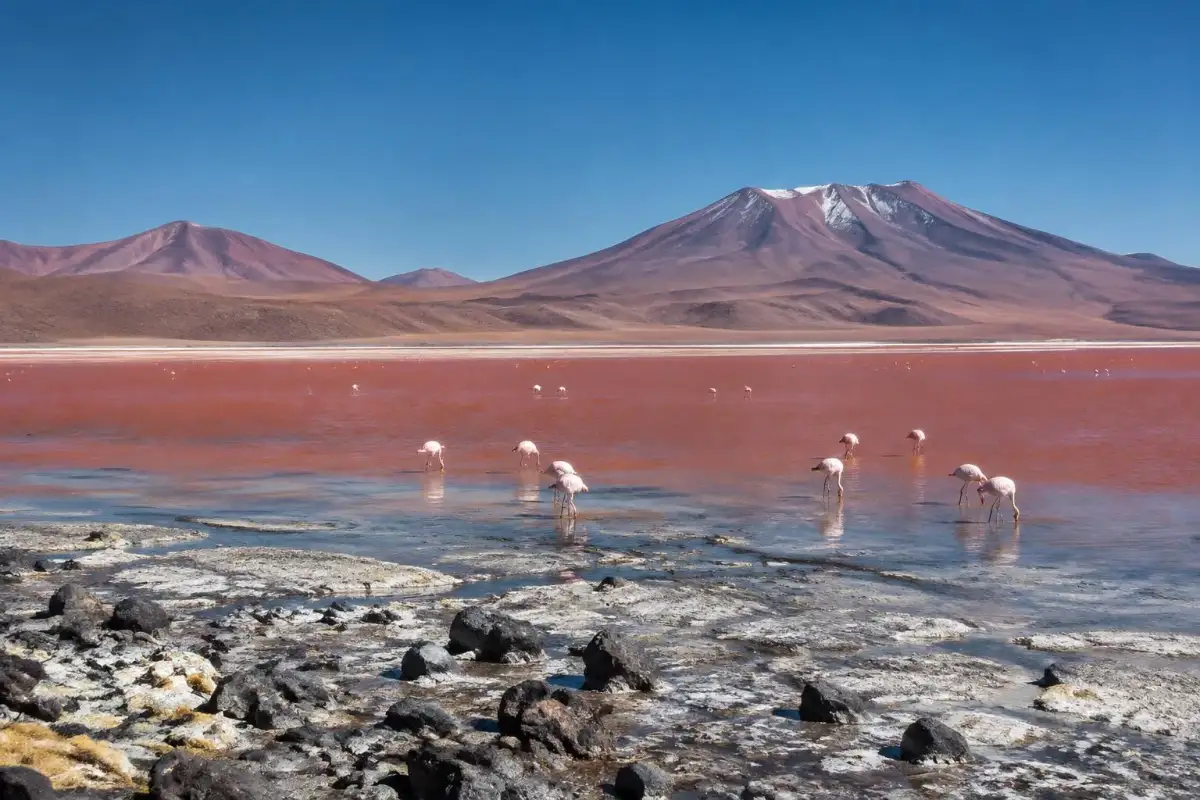
Every traveler who reaches Uyuni ends up at the same crossroads: do you spend one day on the salt flat, or do you commit to three or four days crossing the high desert in a 4×4? The answer changes your whole trip. A 1-day tour shows you the Salar itself, which is the reason most people come. A multi-day route adds red lagoons full of flamingos, a geyser field near 5,000 m and a hot spring at dawn, but it also adds cold nights, basic lodges and long hours in a vehicle.
We grew up in Bolivia, and the question we get asked most by friends and readers is exactly this one: which salar de uyuni tour should I book? In this guide we break down what each format really covers, day by day, so you can compare them honestly. You will find the classic 1-day excursion, the 3-day Salar and deserts route, the 4-day tour that ends with an overnight bus to La Paz, and the private excursion for families and photographers.
We also cover the things that tour pages tend to skip: which fees you pay in cash on the road, what is usually not included, how to tell a careful operator from a careless one, what to tip, and how to choose based on your time, budget, fitness and the season you are traveling in.
Quick answer: Take the 1-day tour if you only want the salt flat and the mirror effect (about 9 hours, max altitude ≈ 3,700 m). Take the 3-day tour if you want the Salar plus Laguna Colorada, the Árbol de Piedra and the Sol de Mañana geysers (up to ≈ 4,900-5,000 m, basic lodges). Choose the 4-day tour if you want a slower pace and to finish on the overnight bus to La Paz, and a private tour if you travel as a family or group and want control over timing. Budget roughly 150 BOB in cash for the Eduardo Avaroa reserve plus about 30 BOB for Isla Incahuasi on multi-day routes.
The Four Salar de Uyuni Tour Formats at a Glance
Almost every operator in Uyuni sells some version of the same four products. The names change from agency to agency, but the routes are very similar because the roads, the lodges and the national park checkpoints are the same for everyone. What changes is the pace, the vehicle, the food, the number of people in the jeep and, above all, the driver.
Here is the short version before we go day by day:
- 1-day group tour: leaves Uyuni mid morning and returns after sunset. Covers the train cemetery, Colchani, the salt flat, a salt hotel, Isla Incahuasi (dry season) and sunset on the Salar.
- 3-day tour (Salar + deserts): day 1 is essentially the 1-day tour, then days 2 and 3 head south through the lagoons and deserts of the Eduardo Avaroa Andean Fauna National Reserve, returning to Uyuni in the late afternoon of day 3.
- 4-day tour: adds a night near Volcán Tunupa and the Coqueza caves, then crosses the reserve more slowly, returns to Uyuni and puts you on an overnight bus to La Paz.
- Private excursion: the 1-day route in your own vehicle with your own driver, with flexible stops and an optional extension to the Tunupa volcano area.
If you are still deciding between seasons, read our guide on when to see the mirror effect first, because the season affects which tours run and which stops are accessible.
The 1-Day Salar de Uyuni Tour, Stop by Stop
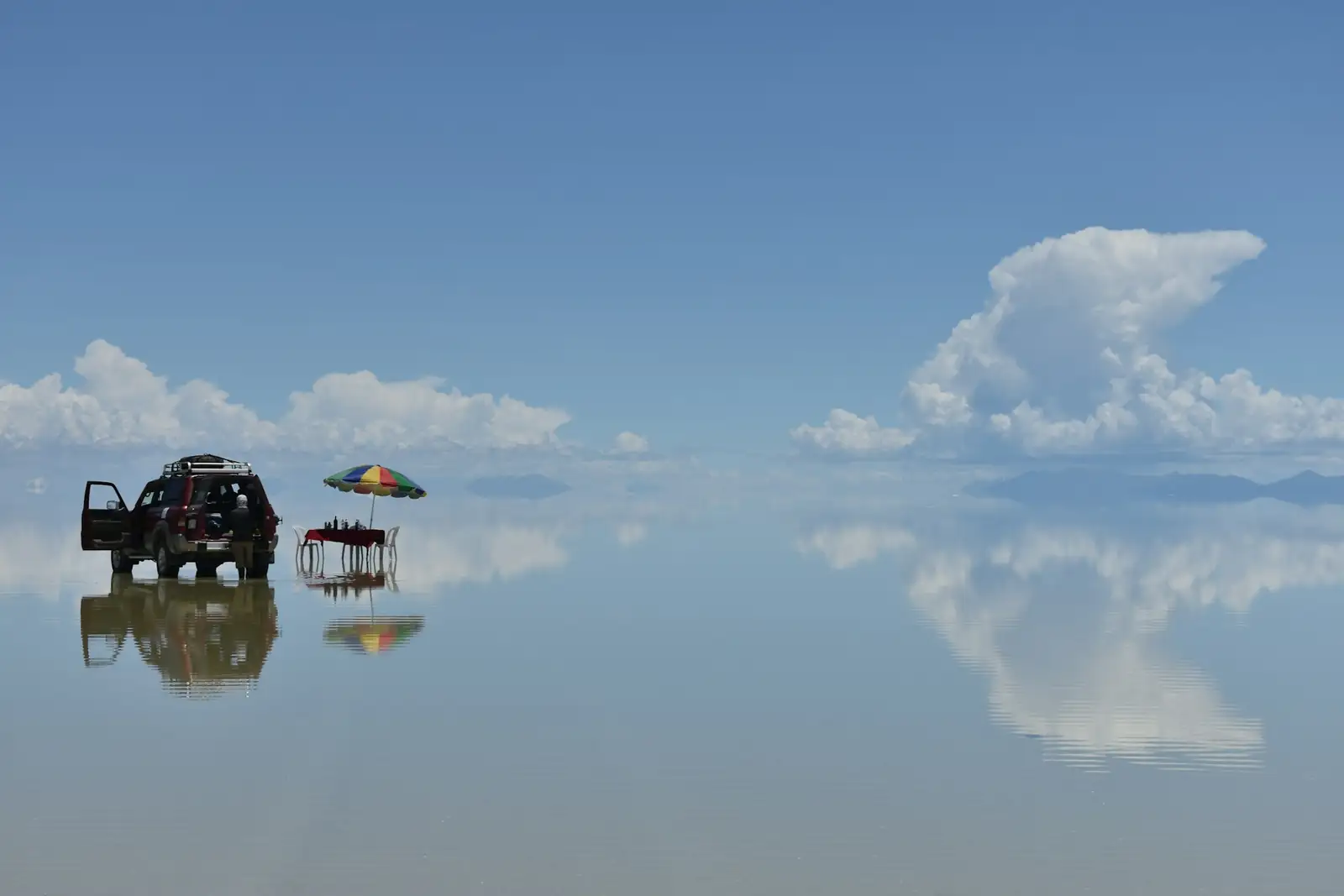
The 1-day tour is the most popular product in Uyuni by a wide margin. It usually starts with pickup at your hotel around 10:00 to 10:30 and ends back in town after sunset, for a total of roughly 8 to 9 hours. Lunch is included and is typically served on the salt, at a table set up next to the jeep or inside one of the salt buildings.
Train cemetery (Cementerio de Trenes)
The first stop is about 3 km outside Uyuni, where dozens of rusting steam locomotives from the late 19th and early 20th century were left when the mining railways declined. It is a short stop, usually 20 to 30 minutes, with a lot of people climbing on the engines for photos. Watch your footing: the metal is sharp and there are no barriers.
Colchani village and the salt processing
Colchani sits at the edge of the Salar, about 20 km north of Uyuni. Here families dry, grind and iodize salt by hand and package it in small bags. You will see the process, and there is a small market with salt figures, llama wool textiles and souvenirs. This is also the last place with real toilets for a while, so use them.
Ojos de Salar and the salt mounds
Depending on the season and the driver, you will stop at the salt piles (the small cones that workers rake up to dry) and at the Ojos de Salar, small holes where water bubbles up from below the crust. In the rainy season these stops can change because the water level decides where the jeeps can go.
The first salt hotel and the Dakar monument
Near the old salt hotel at Playa Blanca you will find the Dakar Rally monument made of salt blocks and the field of flags from many countries that travelers have left over the years. The building itself is now mostly a museum and lunch stop rather than a working hotel. If you want to actually sleep in a salt hotel, we compare the options in our article on salt hotels near the Salar de Uyuni.
Isla Incahuasi (dry season)
Incahuasi is a rocky island in the middle of the Salar, covered in giant cacti, some several meters tall. There is a short trail to the top with a 360-degree view of white salt to the horizon. The entrance is paid separately, about 30 BOB per person in cash. Allow 40 minutes to an hour. In the rainy season, when the Salar is flooded, most 1-day tours cannot reach the island and stay closer to Colchani instead, where the water is shallow enough for the famous reflections.
Perspective photos and sunset
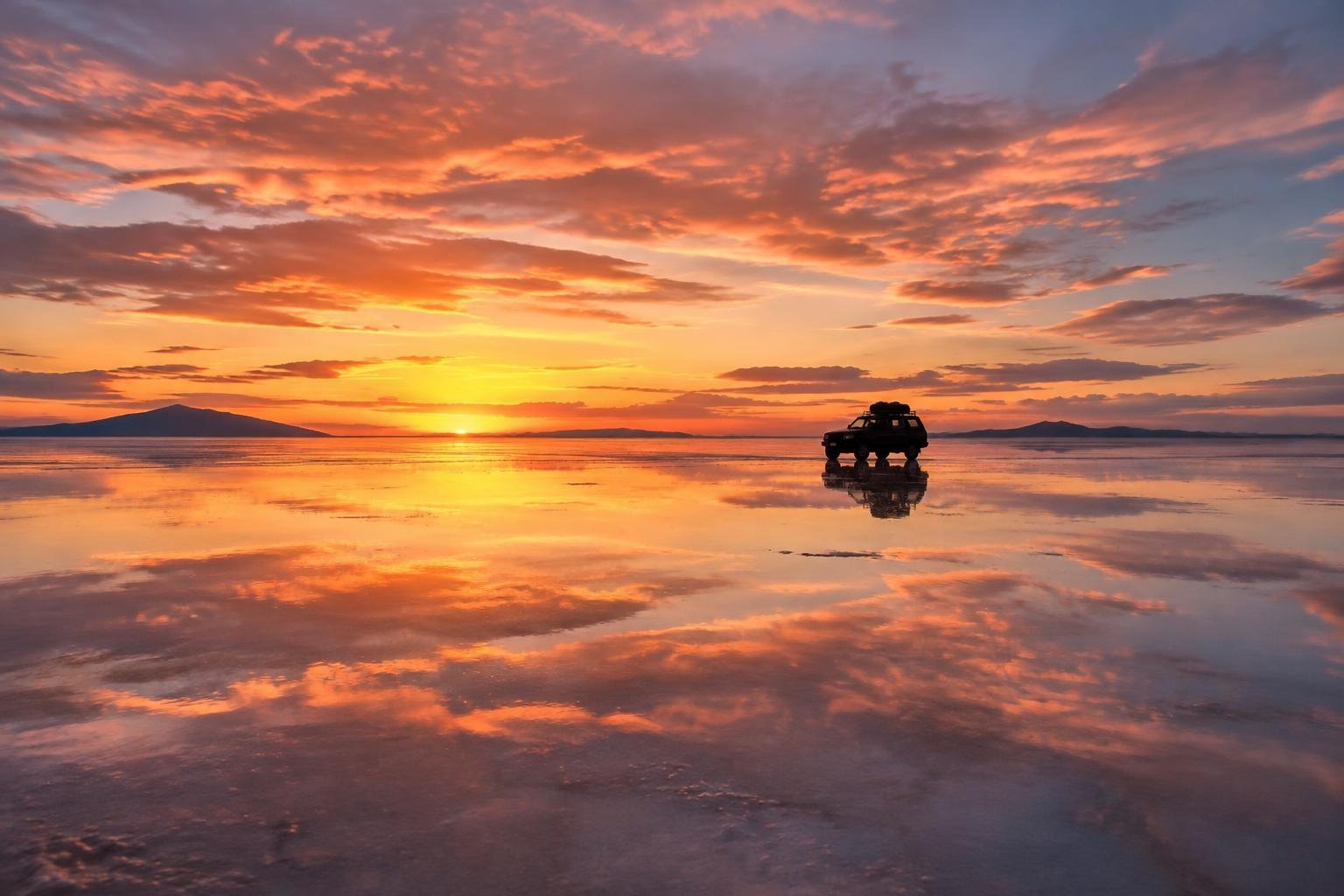
In the dry season your driver will stop on the flat, endless white surface for perspective photos: tiny people standing on a bottle, dinosaurs chasing the group, that sort of thing. Most drivers carry a few props and know the angles. The day ends with sunset on the salt. In the wet months this is when the mirror effect is most dramatic, and it is the single best reason to choose a tour that stays out until dark.
For the 1-day tour the maximum altitude is about 3,700 m, roughly the same as the Salar itself (≈ 3,650 m). If you have spent a few days in La Paz or Potosí you will feel fine. If you flew in from sea level the day before, take it easy.
🗺️ 1-DAY SALAR TOUR
The whole Salar in one long day
Train cemetery, Colchani, the salt hotel, Incahuasi and sunset on the salt, with hotel pickup and lunch included.
See the 1-day tour →✓ Free cancellation up to 24 h before · ✓ Instant confirmation · ✓ Local operators
The 3-Day Tour: Salar, Lagoons and the High Desert
The 3-day tour is the classic overland route of southwest Bolivia. It covers the Salar on day 1, then drives south into the Eduardo Avaroa Andean Fauna National Reserve, a protected area of volcanoes, colored lagoons and desert that runs to the Chilean border. You spend two nights in simple lodges and return to Uyuni around 17:30 on day 3. Most routes are 4×4 jeeps (Toyota Land Cruisers are the standard) with up to six passengers plus the driver, who usually also cooks or travels with a cook.
Day 1: the Salar
Day 1 follows almost the same route as the 1-day tour: train cemetery, Colchani, salt mounds, the old salt hotel and Dakar monument, then Isla Incahuasi and sunset. The difference is that instead of returning to Uyuni you sleep at the southern edge of the Salar, often in villages such as San Juan or Candelaria, sometimes in a lodge built partly of salt. Electricity may only run for a few hours in the evening.
Day 2: volcanoes, flamingo lagoons, Siloli desert and Laguna Colorada
Day 2 is the longest driving day and, for many people, the highlight. You pass a viewpoint over the active Ollagüe volcano on the Chilean border, then a chain of high lagoons (Cañapa, Hedionda, Chiarkota and Honda) where three species of Andean flamingos feed. Then you climb into the Siloli desert, where the wind has carved the famous Árbol de Piedra (Stone Tree), a rock formation shaped like a stunted tree.
The day ends at Laguna Colorada, at around 4,280 m, whose water turns red and orange because of algae and minerals. It is one of the main flamingo nesting areas in the Andes. Entry to the Eduardo Avaroa reserve is checked here or at a ranger post on the way, and this is where you pay the reserve fee in cash. You sleep nearby in very basic lodges, often in the Huayllajara area, at well over 4,000 m. This is the coldest night of the trip, and in June to August the temperature inside an unheated room can drop below freezing.
Day 3: Sol de Mañana geysers, hot springs and the return
You leave before dawn, often around 4:30 or 5:00, to reach the Sol de Mañana geothermal field at sunrise. This is the highest point of the route, about 4,850 to 5,000 m depending on where the jeep stops. Steam vents and boiling mud pools hiss in the cold air. Stay on the marked ground: the crust is thin in places.
Next come the Polques hot springs (Termas de Polques), a natural pool at about 4,400 m with water warm enough to soak in while the air is still freezing. There is a small fee, usually a few bolivianos (we have seen 6 BOB quoted; it changes). Then you cross the Salvador Dalí desert, named for its surreal rock shapes, and reach Laguna Blanca and Laguna Verde at the foot of Licancabur volcano. Some operators drop passengers here who are continuing to San Pedro de Atacama in Chile. Everyone else drives back north through the Valle de Rocas and the mining town of San Cristóbal, arriving in Uyuni in the late afternoon.
🦩 3 DAYS: SALAR + DESERTS
Flamingos, geysers and Laguna Colorada
Two nights in high-desert lodges, meals and 4×4 transport included, returning to Uyuni on day 3.
Check 3-day dates →✓ Free cancellation up to 24 h before · ✓ Real traveler reviews · ✓ Local operators
The 4-Day Tour Ending in La Paz
The 4-day tour covers the same reserve as the 3-day route but splits the driving into shorter days and adds the north side of the Salar, around Volcán Tunupa. In the version we link to, it also ends with an overnight bus from Uyuni to La Paz, so you save a night of accommodation and a separate transport booking.
Day 1: Salar and Coqueza
Pickup is around 10:30 and the first afternoon is the standard Salar circuit: train cemetery, Colchani, the salt hotel and the Incahuasi area. Instead of heading south, you cross to the north shore and sleep in Coqueza, a small village at the foot of Tunupa.
Day 2: sunrise on the Salar and the Tunupa caves
This is the day that makes the 4-day route different. You get up for sunrise on the salt (few 1-day tours offer this), then visit the Coqueza caves with their pre-Inca mummies and walk part of the slope of Tunupa for views over the whole Salar. Overnight is in a village further south such as Colcha K.
Day 3: quinoa country, Chiguana and Laguna Colorada
Day 3 crosses quinoa-growing villages and the smaller Chiguana salt flat, stops at the Ollagüe volcano viewpoint and then enters the Eduardo Avaroa reserve: the Cañapa and Hedionda lagoons with flamingos, the Siloli desert and Laguna Colorada. You sleep near the Polques hot springs, which means a sunset or evening soak is sometimes possible.
Day 4: geysers, Laguna Verde and the bus to La Paz
Another early start for the Sol de Mañana geysers, then the hot springs, the Dalí desert and Laguna Verde under Licancabur. After lunch in Villa Mar and a pass through San Cristóbal, you return to Uyuni in the evening and board the overnight bus to La Paz (roughly 20:30 departure, arriving around 5:30). The ride is long, about 10-12 hours for roughly 550 km, so choose a semi-cama or cama seat if you have the option. Our guide on how to get to Uyuni from La Paz covers buses, flights and the train in detail.
The 4-day route works best for travelers who want more time to adjust to altitude between the Salar and the 5,000 m geysers, for photographers who want a sunrise on the salt, and for anyone who wants to continue directly to La Paz without planning the transfer themselves. Note that this particular product needs a minimum of three participants to run.
The Private Salar Excursion
A private excursion is the 1-day route with your own 4×4 and your own driver. The stops are the same (train cemetery, Colchani salt workshops, the salt hotel area, Incahuasi and sunset), but the timing is yours. If the light is good at the perspective photo spot, you stay. If your kids are tired, you skip a stop. Pickup can be at your hotel, the bus station or the airport.
The version we recommend picks up around 10:00 and returns around 19:00, and offers an extension that starts at 8:00 and adds the Tunupa volcano area with the Coqueza mummies and the Chiquini cave. Small separate fees apply (Incahuasi, the salt factory and the Playa Blanca hotel, each a few dollars or less, paid in cash). Pricing is per group rather than per person, which makes it surprisingly reasonable for four to six people and expensive for a couple.
Private tours make most sense for families with children or older relatives, for photographers who want to wait for the light, for groups of friends who already fill a jeep, and in the rainy season when you want to chase the best mirror spot without a fixed schedule.
🚙 PRIVATE EXCURSION
Your own jeep, your own timing
Ideal for families and photographers, with no other travelers in the vehicle and an optional Tunupa extension.
Get a private quote →✓ Free cancellation up to 48 h before · ✓ Instant confirmation · ✓ Local operators
Salar de Uyuni Tours Compared: The Big Table
This table puts the four formats side by side. Altitudes are approximate and depend on the exact stops; accommodation standards vary by operator and by the option you choose.
| Format | Duration | What you see | Max altitude | Accommodation | Comfort | Best for |
|---|---|---|---|---|---|---|
| 1-day group | ≈ 8-9 hours | Train cemetery, Colchani, salt mounds, salt hotel and Dakar monument, Incahuasi (dry season), sunset | ≈ 3,700 m | None (your Uyuni hotel) | High: back in town at night | Short trips, mirror season, travelers sensitive to altitude |
| 3-day group | 3 days, 2 nights | Salar, Ollagüe viewpoint, flamingo lagoons, Siloli desert and Árbol de Piedra, Laguna Colorada, Sol de Mañana, Polques springs, Laguna Verde | ≈ 4,900-5,000 m | Basic lodges, shared or private bath | Low to medium: cold nights, long drives | Travelers with 3+ days who want the full southwest |
| 4-day to La Paz | 4 days, 3 nights + overnight bus | All of the 3-day route plus sunrise on the Salar, Tunupa, Coqueza mummies, Chiguana flat | ≈ 4,900-5,000 m | Simple 2-star-level lodges | Medium: shorter driving days | Slower acclimatization, photographers, continuing to La Paz |
| Private 1-day | ≈ 9-11 hours | The 1-day stops at your own pace, optional Tunupa extension | ≈ 3,700 m (higher if you hike on Tunupa) | None | Highest: own vehicle, flexible stops | Families, groups of 4-6, photographers |
One thing the table cannot show: the Salar itself is the same on every format. If your goal is the white flat or the mirror reflection, the 1-day tour already gives you that. You add days for the desert, the lagoons and the wildlife, not for “more Salar”.
How to Choose the Right Tour
We find it easier to choose by looking at four constraints: how much time you have, what you can spend, how your body handles altitude and cold, and which season you are traveling in.
| If your situation is… | Choose | Why |
|---|---|---|
| Time: only 1-2 days in Uyuni | 1-day group or private | You see the whole Salar and are back for your night bus or morning flight |
| Time: 3-4 free days in southwest Bolivia | 3-day tour | Covers the main sights of the reserve with the least time spent |
| Time: 5+ days and heading to La Paz next | 4-day tour | Slower pace and the transfer to La Paz is built in |
| Budget: tight (backpacker) | 1-day group; 3-day with shared rooms | Group tours split the jeep cost; shared dorms are the cheapest lodging. Ranges often quoted: ≈ US$60-120 for 1 day, ≈ US$150-300 for 3 days (prices change) |
| Budget: mid-range, group of 4-6 | Private 1-day | Priced per vehicle, so the cost per person falls close to a group tour |
| Fitness: altitude sensitive, heart or lung concerns, small children | 1-day (group or private) | You stay near 3,650-3,700 m and sleep in town |
| Fitness: healthy, already acclimatized in La Paz or Potosí | 3-day or 4-day | The 4,300-5,000 m section is manageable after a few days at altitude |
| Season: rainy (Dec-Apr, mirror best Jan-Mar) | 1-day with sunset, or private | The mirror is the goal; Incahuasi and some southern tracks can be closed by water |
| Season: dry (May-Nov) | 3-day or 4-day | All roads open, Incahuasi accessible, clear skies for stars; pack for very cold nights Jun-Aug |
For more on the cold months and what the salt looks like when it is dry, see our article on the dry season on the Salar. For a broader picture of weather, money and clothing, our overview of where the Salar is and what to expect is a good starting point.
What Is Usually Included, and What Is Not
Tour descriptions in Uyuni look very similar, but the small print is where surprises happen. Here is what we see on most listings, including the four tours we link to on this page.
Usually included
- Pickup in Uyuni (hotel, and often the bus station or airport).
- Transport in a 4×4 vehicle with a driver who doubles as guide.
- Meals: lunch on the 1-day tour; on multi-day tours most breakfasts, lunches and dinners (check the exact count, for example two breakfasts, three lunches and two dinners on a 3-day).
- Accommodation on multi-day tours, with a choice between shared dorms and rooms with private bathroom on some listings.
- Drinking water and sometimes a soft drink.
Usually not included (bring cash)
- Eduardo Avaroa reserve fee: 150 BOB per person for foreign visitors, paid in cash at the ranger post. Only applies to the 3-day and 4-day routes.
- Isla Incahuasi: about 30 BOB per person, cash.
- Polques hot springs: a small fee, usually a few bolivianos.
- Toilets at remote stops: typically a few bolivianos each time.
- Sleeping bag rental: commonly quoted at ≈ US$10-20 for the whole trip. Strongly recommended on multi-day tours, especially May to September.
- Tips for the driver and cook.
- Alcoholic drinks, snacks, and travel insurance.
Some listings quote the combined fees in one figure; for example, the 4-day tour we link to lists about 180 BOB per person in entrance fees. Fees can change, so treat these numbers as a guide and check your booking confirmation. There are no ATMs once you leave Uyuni, and card payments are not accepted at the ranger posts. We suggest carrying around 250-350 BOB per person in small notes for a 3-day or 4-day tour, plus your tips. Our packing list for the Salar de Uyuni covers the layers, sunscreen and headlamp you will need.
🛡️ TRAVEL INSURANCE
Covered at 5,000 meters
Remote roads and high altitude mean a medical evacuation is expensive. Check that your policy covers Bolivia and altitude before you go.
See SafetyWing plans →✓ Buy online in minutes · ✓ Flexible coverage · ✓ Made for travelers
How to Choose a Good Operator
There are dozens of agencies along the streets of Uyuni, and the honest truth is that the operator matters more than the itinerary. Two tours with identical routes can feel completely different depending on the vehicle, the driver and the group. These are the points we would check.
Licensed and registered
Work with an operator that is formally registered and authorized to enter the national reserve. On a booking platform, the listing should name the local company that runs the trip. If you book in person, ask to see their paperwork and a written itinerary with what is included and excluded.
Vehicle condition
Look at the jeep if you can. Tires with tread, working seatbelts in every seat, and a spare tire on the roof are the basics. On multi-day tours the vehicle should carry spare fuel, a first aid kit and, ideally, oxygen for altitude emergencies. Ask how many seats are in use: six passengers is the norm, seven is uncomfortable for three days.
Driver hours and sobriety
The roads south of the Salar are unpaved and isolated, and driving days on multi-day tours can be long. A good operator rotates drivers and does not send someone out the morning after finishing another three-day trip. Over the years there have been serious accidents on these routes, and fatigue and alcohol have been part of the story. If your driver seems tired or has been drinking, say so to the group and contact the agency. It is not rude; it is your safety.
Group size
Group tours usually fill a jeep with up to six travelers. Some 1-day tours run several jeeps together, which is fine. If you value space or quiet, ask about the maximum per vehicle or choose a private tour.
Language: English or Spanish guide
Most standard tours in Uyuni, including the Civitatis listings we link here, are run by a Spanish-speaking driver. The driver explains the stops, but it is not a lecture-style guided tour. If you do not speak Spanish and want detailed explanations, ask for an English-speaking guide before you book; it is usually possible on private tours for an extra cost, and some agencies offer it on group departures on fixed dates. A translation app and a few basic phrases go a long way.
Reviews and recent feedback
Read recent reviews rather than the overall score. Look for comments about the driver, the food and the condition of the lodges in the last few months. Complaints repeated by several travelers are a clear signal. You can always message us on WhatsApp if you are unsure about a specific itinerary.
Tipping and Etiquette on the Salar
Tipping is not mandatory in Bolivia, but on tours it is expected and much appreciated. Drivers and cooks earn modest wages and work long hours far from home.
- 1-day tour: around 20-50 BOB per person for the driver is a common amount if the service was good.
- Multi-day tours: travelers often quote roughly 50-100 BOB per person in total for the driver-guide and the cook, given at the end of the trip. Pooling the tip as a group and handing it over together works well.
- Tip in bolivianos, in cash. Dollars are harder for drivers to use.
A few points of etiquette make the trip better for everyone:
- Be on time. Departures are tight, especially the pre-dawn start to the geysers. Six people waiting for one is a bad way to start the day.
- Ask before photographing people in Colchani and the villages. Some will ask for a small tip, and that is fair.
- Do not take salt, rocks or anything from the reserve. Do not approach the flamingos; stay on the paths at the lagoons.
- Carry your trash back. The lodges have no proper waste collection. A small bag in your daypack is enough.
- Share the front seat. On multi-day tours the front passenger seat is the best one; rotate it among the group.
- Keep the music volume reasonable and agree on it as a group.
Why We Book Through Civitatis
We send our readers to Civitatis because it solves the main problems of booking a tour in a small town from abroad. The tours themselves are run by local, licensed Bolivian companies; Civitatis is the booking platform.
- Free cancellation on most tours. The 1-day, 3-day and 4-day tours we link to allow free cancellation up to 24 hours before; the private tour up to 48 hours. That matters in Bolivia, where road blockades and flight changes happen.
- Verified reviews. Reviews come from travelers who booked and took the tour, so you can read recent comments about drivers and lodges.
- Instant confirmation and a clear list of what is and is not included, in writing, before you pay.
- Pickup arranged at your hotel in Uyuni, the bus terminal or the airport.
Booking in person in Uyuni can be slightly cheaper in low season, but you lose the cancellation protection and have to compare agencies on the day you arrive, often tired and at altitude. In high season (July, August and around New Year) good departures fill up, so booking ahead is the safer choice. You can see all the options we recommend in the tours section of our site.
🏔️ 4 DAYS: UYUNI TO LA PAZ
Sunrise on the salt, geysers at 5,000 m
Three nights of lodging, meals and the overnight bus to La Paz included, at a slower pace than the 3-day route.
Check 4-day availability →✓ Free cancellation up to 24 h before · ✓ Instant confirmation · ✓ Local operators
Where to Sleep Before and After Your Tour
Every format starts in Uyuni, so you will need at least one night in town, and two if you arrive on the overnight bus and want to rest before a multi-day trip. Uyuni has simple hostels, mid-range hotels with heating, and a few salt hotels on the edge of the Salar near Colchani. Heating is the one feature we would not compromise on between May and September. Check current prices and reviews on Booking.com, and book early for July, August and the New Year period.
🏨 HOTELS IN UYUNI
A warm room before the early start
Compare hotels and salt hotels near the Salar and filter by heating and free cancellation.
Find a hotel in Uyuni →✓ Free cancellation on many rooms · ✓ Verified guest reviews · ✓ Pay later options
Practical Tips for Any Salar de Uyuni Tour
Acclimatize first
The Salar sits at about 3,650 m and the multi-day routes climb to around 5,000 m. Spend at least two or three days at altitude (La Paz, Sucre or Potosí) before a 3-day or 4-day tour. Drink water, eat light, skip alcohol the first nights, and tell your driver if you feel a strong headache, nausea or shortness of breath at rest. Descending is the treatment that works.
Dress in layers
Days on the salt can reach 15-20 °C in the sun, while nights in the reserve drop well below freezing, especially from June to August. Bring a warm jacket, thermal base layer, hat, gloves and warm socks for sleeping. In the rainy season, rubber boots are often provided by the operator for the flooded Salar; confirm before you go.
Protect your eyes and skin
The white salt reflects a huge amount of sunlight at high altitude. Sunglasses with UV protection, a high SPF sunscreen and lip balm are essential. Sunburn on the Salar happens fast, even on cool days.
Battery and connectivity
Lodges in the reserve have limited electricity, often only for a few hours in the evening, and mobile signal is patchy or absent. Bring a power bank, download offline maps and let someone know your itinerary. Cold drains batteries quickly, so keep spares in an inside pocket.
Frequently Asked Questions
Which Salar de Uyuni tour is best for first-time visitors?
If you have only one or two days, the 1-day tour is the best introduction: it covers the train cemetery, Colchani, the salt hotel, Isla Incahuasi in the dry season and sunset on the salt. If you have three or more days and you are already acclimatized, the 3-day tour adds Laguna Colorada, the Árbol de Piedra and the Sol de Mañana geysers, which many travelers consider the highlight of southwest Bolivia.
Is the 1-day tour enough to see the Salar de Uyuni?
Yes, for the salt flat itself. The Salar is the same on every format, so the 1-day tour already shows you the white flat, the perspective photos and, in the rainy season, the mirror effect at sunset. You add days to see the lagoons, deserts, geysers and flamingos of the Eduardo Avaroa reserve, not to see more of the Salar.
How much is the Eduardo Avaroa reserve entrance fee?
The entrance fee for foreign visitors is 150 BOB per person, paid in cash at the ranger post. It only applies to the 3-day and 4-day tours that enter the reserve. Add about 30 BOB for Isla Incahuasi and a few bolivianos for the hot springs and toilets. Fees can change, so check your booking details.
What is the maximum altitude on a 3-day Uyuni tour?
The highest point is the Sol de Mañana geothermal field, at roughly 4,850 to 5,000 m depending on the stop. The Salar itself is about 3,650 m, Laguna Colorada about 4,280 m and the lodges near the lagoon sit well above 4,000 m. Spend two or three days at altitude before the tour.
Do I need a sleeping bag for a multi-day tour?
We strongly recommend one. Lodges in the reserve are unheated and nights drop below freezing, especially from June to August. Most operators rent sleeping bags for around US$10-20 for the whole trip, but it is usually not included, so ask when you book.
Can I see the mirror effect on a 3-day tour?
Sometimes, but the 3-day tour is mainly a dry season product. In the rainy season (December to April, best January to March) the flooded Salar can block the route to Isla Incahuasi and to the south, and operators may change the itinerary. If the mirror is your priority, a 1-day tour with sunset or a private tour is the better choice.
Are Salar de Uyuni tours guided in English?
Most standard group tours, including the ones we link to, are run by a Spanish-speaking driver who explains the stops. English-speaking guides are usually available on private tours for an extra cost, and some agencies offer them on fixed group departures. Ask before you book if this matters to you.
How much should I tip on a Salar de Uyuni tour?
Tipping is not mandatory but is expected. For a 1-day tour, around 20-50 BOB per person for the driver is common. For multi-day tours, travelers often give roughly 50-100 BOB per person in total for the driver-guide and cook. Tip in cash, in bolivianos.
Is the 4-day tour worth it compared to the 3-day tour?
It is worth it if you want a slower pace, a sunrise on the Salar, the Tunupa volcano and Coqueza caves, and a built-in overnight bus to La Paz. If your time is limited, the 3-day tour covers the main sights of the reserve in one day less.
Is a private Salar de Uyuni tour worth the price?
For families and groups of four to six, yes: the price is per vehicle, so the cost per person approaches a group tour while you control the timing and stops. For a couple or a solo traveler it is much more expensive than joining a group, and it is mainly worth it for photographers or anyone who needs flexibility.
Conclusion: Pick the Tour That Fits Your Trip
There is no single best salar de uyuni tour, only the one that fits your days, your budget and your body. If you want the salt flat and the mirror, the 1-day tour gives you the essential experience and gets you back to a warm bed. If you want the full southwest of Bolivia, with flamingo lagoons, the red water of Laguna Colorada and the steam of Sol de Mañana at dawn, the 3-day tour is the classic choice, and the 4-day version adds a sunrise on the Salar and an easy onward trip to La Paz. If you travel as a family or a small group, a private excursion gives you the Salar on your own schedule.
Whatever you choose, carry cash for the fees, pack for real cold, give your body time to adjust to the altitude, and pick an operator you trust. Then book early if you are going in July, August or over New Year. Start with the 1-day Salar tour or the 3-day Salar and deserts tour, and if you have questions about which one suits your dates, write to us. You can also read more about our family and why we built this guide, or go back to the Mirror of the World home page for everything else about the Salar.