
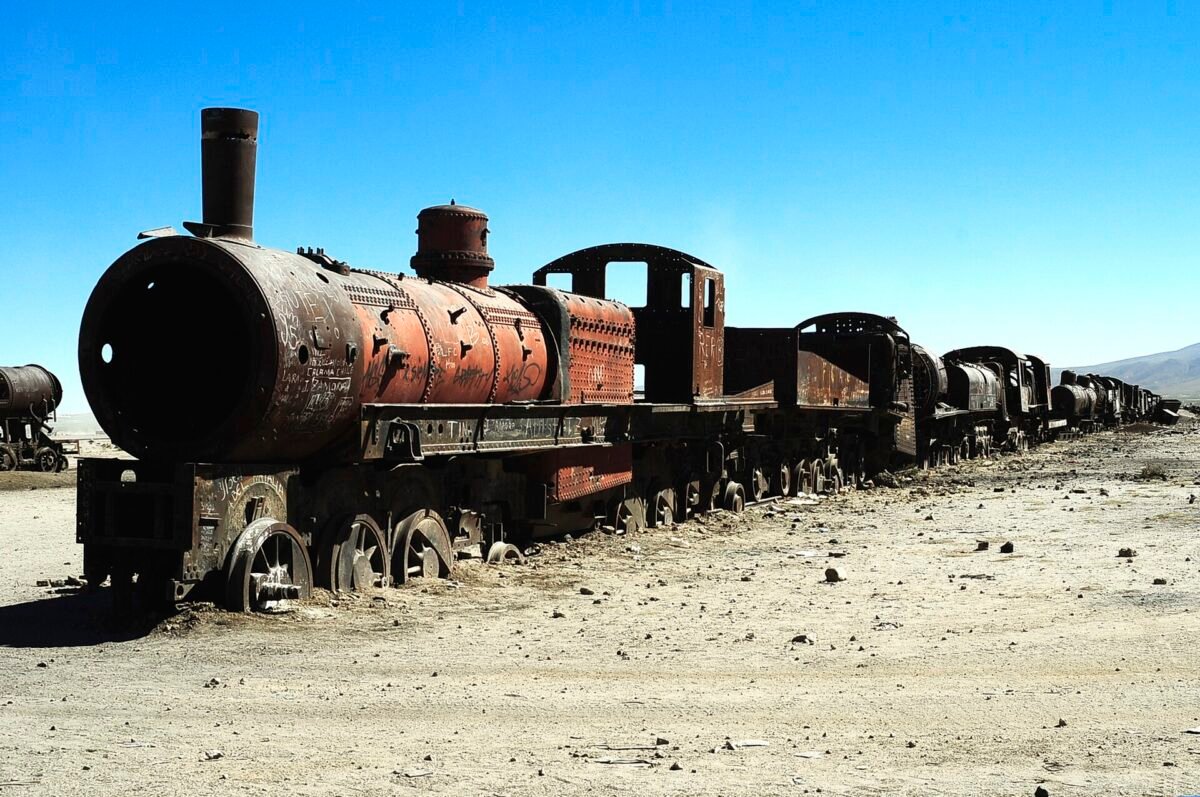
Almost every Salar de Uyuni day trip starts in the same strange place. Before you see a single mile of white salt, your driver turns off a dusty road just outside town and parks next to a field of rusted locomotives. This is the Uyuni train cemetery, the Cementerio de Trenes, and twenty minutes later most groups are back in the jeep, heading north to Colchani, the salt village that sits at the edge of the flats. Both stops tend to get rushed. They deserve better than that.
We grew up in Bolivia, and for us these places are more than photo stops. The trains explain why the town of Uyuni exists at all. Colchani explains how ordinary families still live off the salar. In this guide we cover the history of the Antofagasta–Bolivia railway and why the trains were left to rust, what you will actually see, how far everything is from Uyuni town, what we know (and don’t know) about fees, whether to go on your own or with a tour, the best time for light and smaller crowds, how to photograph the site, and how to stay safe climbing on old metal. Then we head to Colchani: the salt cooperatives, the processing sheds, the handicraft market, the little salt museum, and the nearby Dakar monument, Plaza de las Banderas and one of the first salt hotels. We finish with how it all fits into a one-day tour.
The Uyuni train cemetery at a glance
Here is the short version before we get into the details. The train cemetery sits about 3 km outside Uyuni, close to the old railway tracks that leave town toward the southwest. It is an open field of locomotives, tenders and wagons. Most sources count more than 100 cars. There is no fence, no guard and very little signage, so you can walk among the trains and climb into many of them. Colchani is a different kind of stop: a small working village about 22 km north of Uyuni, right where the main road reaches the Salar de Uyuni.
| Detail | Train Cemetery (Cementerio de Trenes) | Colchani salt village |
|---|---|---|
| Distance from Uyuni town | About 3 km, walkable | About 22 km north, around 40 minutes by local bus |
| Altitude | Roughly 3,700 m (12,100 ft) | Similar, on the edge of the salar |
| What you see | 100+ rusted locomotives and wagons, graffiti, swings and metal art | Salt processing sheds, handicraft stalls, a salt museum, salt sculptures |
| Typical time on a tour | 20–40 minutes | 30–45 minutes |
| Fences or guards | None, open site | A normal village; shops and workshops are private businesses |
| Best time to visit | Before 8 am or after 5 pm, outside the tour rush | Mid-morning, when workshops are active |
| Included on 1-day salar tours? | Yes, almost always the first stop | Yes, usually the second stop |
History: why there is a train cemetery in Uyuni
To understand the trains you have to understand what Uyuni was built for. It was never a tourist town. It was founded around 1890 as a trading post and rail junction on the Altiplano, and for decades its whole reason to exist was moving minerals from Bolivian mines to the Pacific coast.
The Antofagasta–Bolivia railway
The key line was the railway from Antofagasta, on the Pacific, up to the Bolivian highlands. It was built by the British-backed Antofagasta and Bolivia railway companies, and the stretch into Bolivia was constructed between 1888 and 1892, encouraged by President Aniceto Arce, who had made his own fortune in silver mining. British engineers led the work. On November 20, 1890, a train stopped at Uyuni for the first time, carrying Arce himself to celebrate Bolivia’s first railroad built to carry minerals. The work was not welcomed by everyone. Local Indigenous communities sometimes sabotaged the construction, seeing the line as an intrusion on their land.
Uyuni grew into a junction where four lines met: north to Oruro and La Paz, west to Calama and Antofagasta in Chile, east to Potosí, and south to Villazón on the Argentine border. Silver, tin and other minerals came down from mining areas such as Pulacayo, the silver mines a short distance from Uyuni, and went out through Chilean ports. Bolivia had lost its own coastline in the War of the Pacific (1879–1884), so every ton of ore had to cross a border before it reached a ship. That detail matters. It meant Bolivia’s mining economy depended on a railway and a port it did not fully control.
Why the trains were abandoned
Uyuni had workshops where locomotives and wagons were repaired. When the mining industry collapsed in the 1940s, partly because key deposits were running out, the railway lost much of its cargo. Engines and cars that had been sent to Uyuni for repair or storage were simply never put back into service. They were pushed onto sidings outside town and left there. Most of the rolling stock you see today dates from the early 20th century and was imported from Britain.
There were later ideas to reuse or display the old equipment, but they went nowhere, and the Bolivian railways were nationalized in the meantime. What remained was a scrapyard nobody owned in a practical sense. Decades of salty wind blowing off the salar did the rest. Salt speeds up corrosion, which is why the metal here looks far older than it is. Pieces were stripped and sold, visitors added graffiti, and the site slowly became what it is today: half industrial ruin, half open-air art gallery.
You will hear a few legends from guides. The most common is that one of the trains was robbed by Butch Cassidy and the Sundance Kid, who did spend their last days in southern Bolivia. It makes a fun story, but nobody has ever shown which wagon that would be, so treat it as folklore. A more recent claim to fame is pop culture: the site inspired a setting in the video game Ghost Recon Wildlands, which is why some younger travelers recognize it before they arrive.
🚂 ONE-DAY SALAR TOUR
Trains, salt village and sunset in a single day
The classic full-day tour stops at the train cemetery, Colchani and Isla Incahuasi before sunset on the flats, with hotel pickup, jeep transport and an English-speaking guide.
See the full-day tour →✓ Free cancellation up to 24 hours before · ✓ Lunch included · ✓ Book online in English
What you see at the Cementerio de Trenes
Expect a flat, dusty field with lines of trains stretching away from you, the Altiplano behind them and usually a hard blue sky above. The rolling stock is a mix: steam locomotives with their boilers and smokestacks still intact, coal tenders, flatbed cars, boxcars with no roofs, and wheel sets lying loose in the dirt. Some of the steam engines are surprisingly complete. Others are little more than frames.
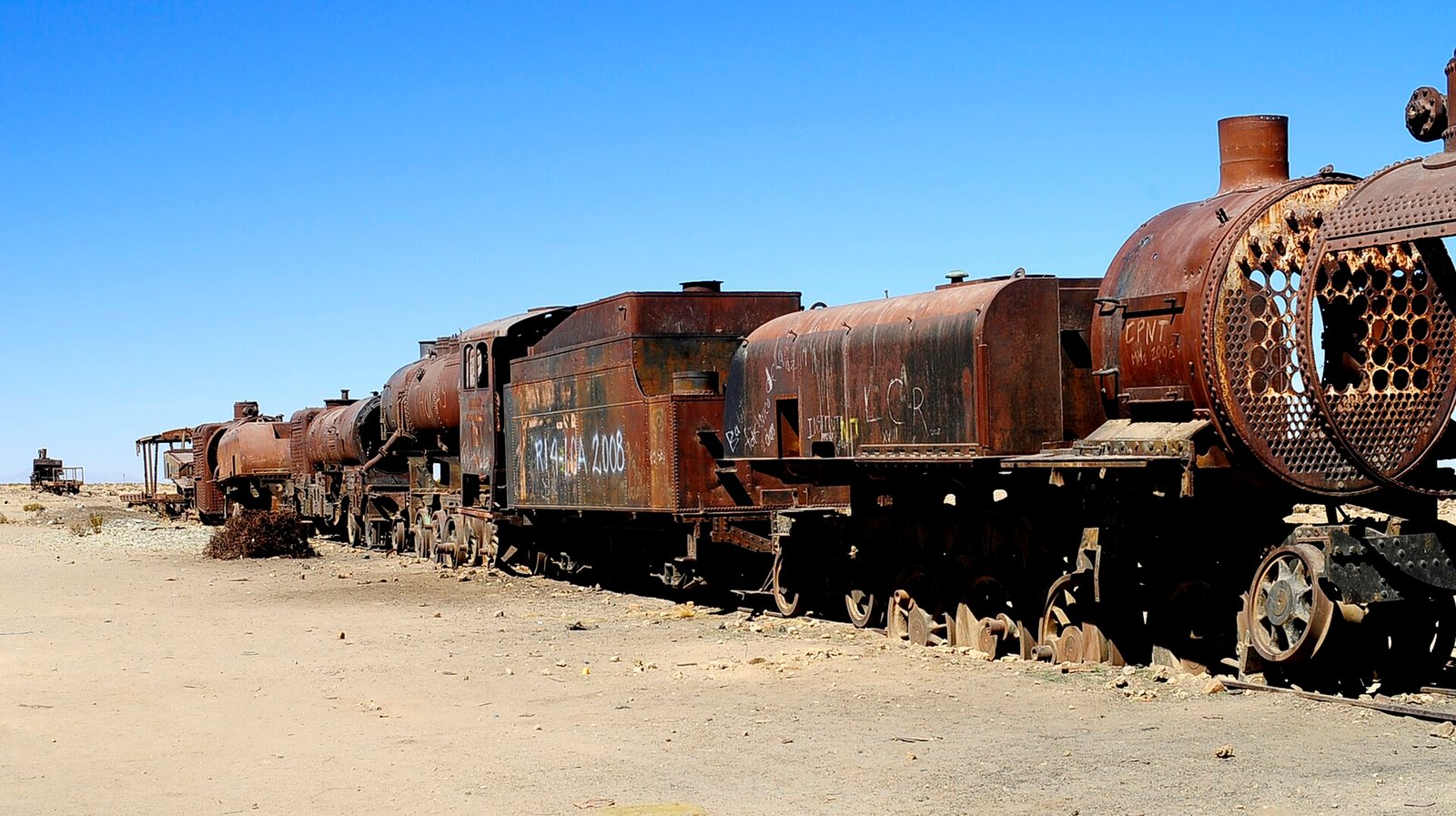
Over the years locals and visitors have turned parts of the site into a playground. You will see swings hung from the frames of wagons, welded metal sculptures made from train parts, and a lot of spray paint. Some of the graffiti is clever, much of it is just names. It changes from year to year, so your photos will never look exactly like the ones you saw online.
There are also usually a few handicraft and snack sellers near where the jeeps park, especially in high season. It is a good place to buy a bottle of water if you forgot one, but Colchani has a much bigger choice of souvenirs.
How long you need
On a standard tour you get about 20 to 40 minutes, which is enough to walk the main line of trains and take your photos. If you are a railway enthusiast or a serious photographer, give yourself an hour or more on your own, ideally at a quieter time of day. The site is larger than it looks from the parking area, and the far ends of the lines are much emptier than the first few engines.
Distance from Uyuni and how to get there
The train cemetery is about 3 km from Uyuni’s railway station. If you are already in town, you have three easy options.
- Walk. Follow the railway tracks out of town toward the southwest. It is flat and takes most people 30 to 45 minutes each way. Remember you are at roughly 3,700 m, so take it slowly on your first day.
- Taxi. Taxis in Uyuni are cheap and the ride is short. Agree on the price before you get in, and ask the driver to wait or come back for you, since there are few taxis at the site outside tour hours.
- On a tour. Almost every one-day and multi-day salar tour stops here first, so if you are booked on one, you do not need to go separately unless you want better light.
If you have not reached Uyuni yet, our guide on how to get to Uyuni from La Paz compares the bus, train and flight options, including the overnight buses that arrive early in the morning. Arriving at dawn is actually a good excuse to visit the trains before the tours do.
Is there an entry fee?
Historically, no. The train cemetery has been an open site with no gate, no guards and no ticket booth, and the recent travel accounts we checked while researching this guide (2024–2026) do not mention paying to enter. That said, entry rules around Uyuni do change, and local communities sometimes introduce small charges at popular spots. We could not confirm a current official fee, so we are not going to quote one. Carry some small bolivianos notes just in case, and if you are on a tour, ask your agency whether any site fees are included. Tour prices usually cover the train cemetery and Colchani, while the entrance to Isla Incahuasi is charged separately.
Local tip: Bring small bills (10 and 20 bolivianos). Toilets, snacks and small purchases in Colchani and at the trains are paid in cash, and sellers often cannot break a 100 or 200 note.
Visiting on your own vs. with a tour
This is one of the few stops on the Salar de Uyuni circuit that you can easily do independently. Colchani is also reachable on your own by local bus, since buses heading to Oruro pass through the village. The flats beyond Colchani are a different story. Driving onto the salar without local knowledge is risky, especially in the wet season, and we always recommend a licensed operator for that part. Here is how the options compare.
| Factor | On your own | Shared 1-day tour | Private tour / driver |
|---|---|---|---|
| Getting to the trains | Walk about 3 km or take a short taxi | Included, first stop | Included, at the time you choose |
| Getting to Colchani | Local bus toward Oruro, about 40 minutes | Included, second stop | Included |
| Crowds at the trains | You can go at sunrise or late afternoon when it is quiet | Busy, since most jeeps arrive late morning together | You can ask to go early or late |
| Historical context | Only what you read beforehand | Short explanation from the guide | More time to ask questions |
| Access to the salt flats afterward | Not recommended without a 4×4 and local driver | Included, with Incahuasi and sunset on most itineraries | Included, flexible stops |
| Approximate cost | Lowest: taxi and bus fares only | An English-guided full day on Civitatis starts from about US$107 at the time of writing | Highest; varies by agency and season |
Our honest advice: if you are only in Uyuni for one day, the train cemetery stop on a tour is enough. If you have a spare evening or arrive early in the morning, walk out to the trains on your own for better light and fewer people, and then enjoy the tour for the salar itself. To understand how different agencies structure their days, read our Salar de Uyuni tours compared guide, and for full numbers see our Salar de Uyuni trip cost and budget breakdown.
Best time to visit: crowds and light
The tour schedule decides when the train cemetery is crowded. Most one-day tours leave Uyuni in the late morning, and since the trains are the first stop, dozens of jeeps tend to arrive at roughly the same time. From late morning to early afternoon you will share every locomotive with other groups. Before about 8 am and after about 5 pm the site is usually much quieter.
Light follows the same pattern. At midday on the Altiplano the sun is almost overhead and very strong, which flattens the rust and makes the sky look washed out. Early morning and late afternoon give you side light that brings out the texture of the metal, long shadows across the dirt and a warmer color on the trains. Sunset here can be very good, with the engines in silhouette against an orange sky.
Seasonally, the trains are interesting all year. The rainy months (roughly December to March) can bring dramatic clouds and occasional puddles that reflect the engines, while the dry season (roughly May to October) brings clear skies, colder mornings and a lot of dust. If you are choosing your travel month for the salar itself, read our guides to the Salar de Uyuni dry season and to when to see the mirror effect, because that decision matters far more than anything at the trains.
🧂 SLEEP NEAR THE SALAR
Stay in a hotel built from salt
Several salt hotels sit near Colchani and on the edge of the flats, so you can be on the salar at sunrise and skip the morning drive from Uyuni town.
Check salt hotels on Booking.com →✓ Compare prices and photos · ✓ Many rooms with free cancellation · ✓ Real guest reviews
Photography tips at the train cemetery
This is one of the most photographed spots in Bolivia, which makes it a challenge to get images that look different. A few things that work for us:
- Walk to the far end. The first engines near the parking area are always crowded. The farther you walk along the lines, the fewer people end up in your frame.
- Shoot low. Crouch near the wheels and shoot up toward the boilers. The engines look bigger and the sky fills the background instead of other tourists.
- Use the lines. The rows of wagons and the old tracks make strong leading lines toward the horizon. A wide-angle lens or the 0.5x on a phone works well.
- Look for details. Rivets, rust patterns, maker’s plates and old couplings make good close-ups and tell the story of British-built machines better than wide shots.
- Protect your gear. Wind carries fine salt and dust. Change lenses inside a bag or the jeep, and wipe your camera at the end of the day. Salt is corrosive to electronics too.
- Try night photography if you stay in town. On clear nights in the dry season, the trains under the stars are spectacular. Go with someone, bring a headlamp and do not climb in the dark.
Safety on the rusted trains
There are no restrictions on climbing, and almost everyone does it. That freedom is part of the charm, but the metal is old and has been corroded by salt for decades. We have seen people slip off roofs and cut their hands on sharp edges. Keep these rules in mind:
- Test before you trust. Ladders, handrails and roof panels can be rusted through. Push on every step before putting your weight on it.
- Wear closed shoes and consider light gloves. Sandals and rusty steel are a bad combination, and there are loose bolts and sharp sheet metal everywhere.
- Check your tetanus vaccination before the trip. A small cut from rusty metal is the most likely injury here.
- Watch the altitude. Climbing onto a locomotive at 3,700 m can leave you breathless, especially on day one. Our guide to altitude sickness on the Uyuni trip explains how to acclimatize.
- Supervise children closely. There are gaps, holes in floors and high drops with no railings.
- Respect the wind. Gusts on the Altiplano can be strong. Do not stand on the edge of a roof for a photo when it is windy.
- Keep your belongings close. The site is generally calm, but it is busy and open. Do not leave bags unattended while you climb.
🛡️ TRAVEL INSURANCE
Remote Altiplano trip? Get covered first
Between rusty trains, high altitude and long jeep days far from hospitals, it pays to have medical cover that works while you are already traveling.
Check SafetyWing coverage →✓ Buy online in minutes · ✓ Can be purchased after you leave home · ✓ Read the policy details before buying
Colchani: the salt village at the edge of the salar
Colchani is about 22 km north of Uyuni, at the point where the road meets the eastern edge of the Salar de Uyuni. It is the easiest place to reach the salt flat, which is why almost every tour drives through it on the way onto the salt. It is a small, dusty village of adobe and salt-block houses, and for many families here salt is the main source of income. It does not look like much at first, but if you take a few minutes to watch the workshops, you will understand the salar in a way the white horizon alone cannot teach you.
How salt is extracted on the salar
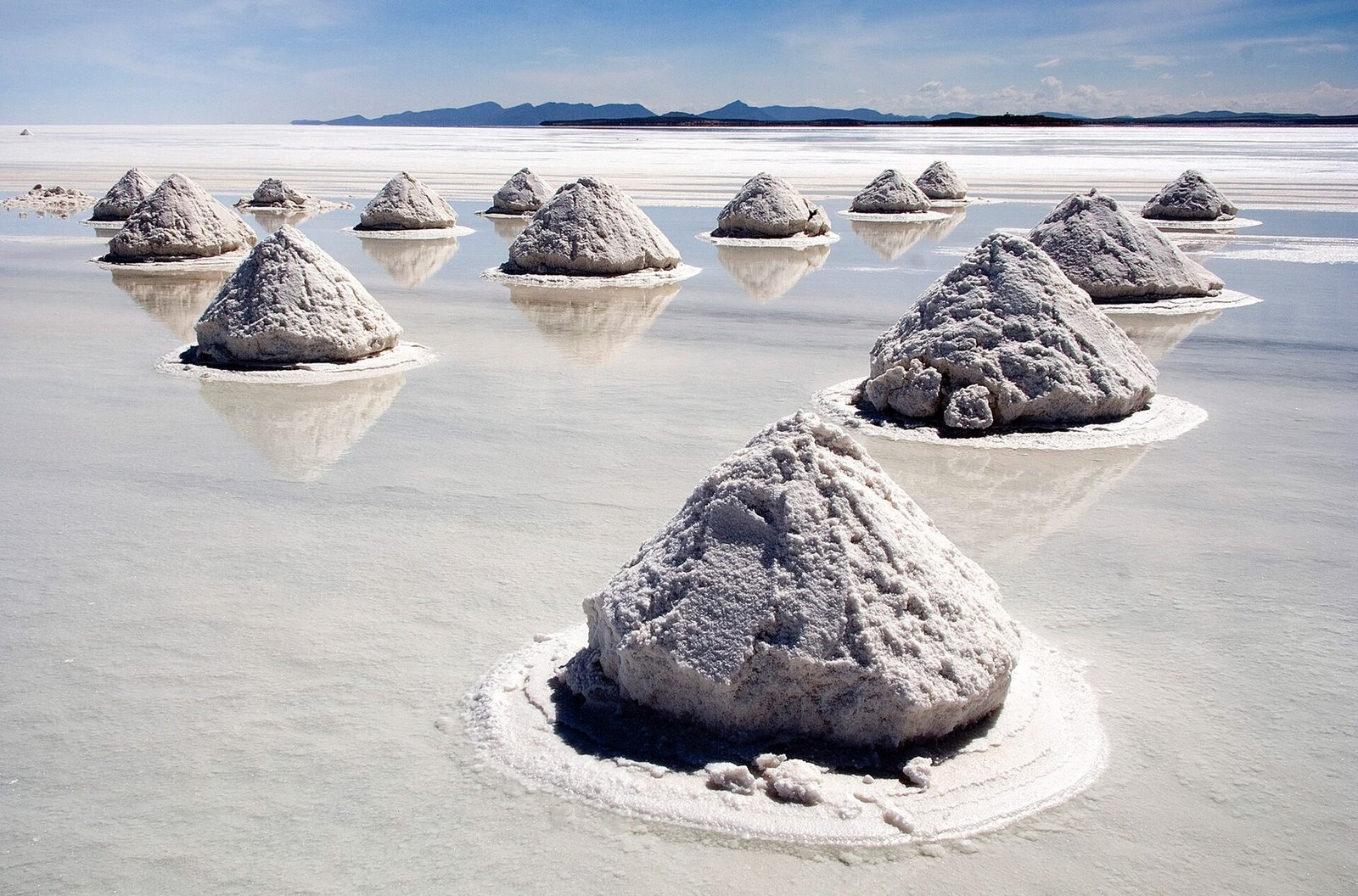
Out on the flats near Colchani, salt workers use pickaxes and shovels to scrape up the crust of halite crystals and rake it into small pyramids. These piles are left in the sun and wind to drain and dry. You will see neat rows of them from the road, and many tours stop for photos among them. Annual extraction from the whole salar has been estimated at around 25,000 tonnes, tiny compared with the billions of tonnes the salar holds. Work is hardest in the rainy months, from about November to March, when a few centimeters of water can cover the surface and take days to evaporate.
Processing: drying, iodizing and bagging
Once dry, the salt is trucked into Colchani. In family workshops and small plants it is dried further over ovens, mixed with iodine, ground into fine table salt and packed into small plastic bags, often of one kilogram, which are then sealed by hand over a flame. Much of this is still done manually, and it is common to see a whole family working together on the bagging. Most tours stop at one of these workshops so you can see the process and buy a bag of salt to take home.
Iodization is not a small detail. Iodized salt prevents iodine deficiency, and in recent years local producers around Colchani and Uyuni have worked with nutrition organizations to improve how they measure and add iodate, upgrade their facilities and dry the salt better. Rising costs of potassium iodate have been a real challenge for small producers. When you buy a bag of local salt, you are supporting exactly these family operations.
The salt cooperatives
Salt extraction around Colchani is organized through cooperatives and producers’ associations rather than large companies. The best known is the Cooperativa Rosario, which works the salt near the village. The cooperative system gives families rights to work certain areas of the salar and a way to sell their product together. Incomes are modest. Reports on the work describe long hours and very low pay per bag filled, and many people combine salt work with tourism, handicrafts or farming. Keep that in mind when you are bargaining over a few bolivianos for a souvenir.
The handicrafts market
Colchani’s main street is lined with stalls selling hand-knitted hats, scarves, gloves and sweaters, ponchos, jewelry, and small objects carved from salt: llamas, dice, ashtrays and miniature figures. It is one of the best places on the circuit to buy warm layers if you underestimated the cold. Prices in the Uyuni area are higher than in La Paz, and some travelers find alpaca pieces cheaper in Peru, but buying here supports the village directly. Bargaining a little is normal, but be fair.
The salt museum and salt sculptures
Colchani has a small salt museum, a building made of salt blocks with sculptures carved from salt inside, usually next to the souvenir stalls. Admission has traditionally been free or covered by your tour, though some stalls ask you to buy something or pay a small amount to use the bathroom. In 2026, local residents and artisans have also been carving larger outdoor salt sculptures around Colchani, including pyramids, animals such as condors, owls, foxes, llamas and armadillos, and a pair of giant hands nicknamed the “Mano de Dios” (Hand of God). These are new, so they may or may not be on your tour’s route yet. Ask your driver.
🏨 BASE YOURSELF IN UYUNI
Find a warm room close to the tour offices
Staying in Uyuni town puts you a short walk from the train cemetery and the agencies, with easy comparison of rates and locations in one search.
Search Here for Hotels.com Best Hotel Deals!✓ Compare hotels in Uyuni · ✓ Filter by heating and breakfast · ✓ Check cancellation terms before booking
Beyond Colchani: Dakar monument, Plaza de las Banderas and the first salt hotel
From Colchani, tours drive west onto the salt. A short distance onto the flats there is a cluster of stops that most itineraries combine into one: the Dakar monument, the Plaza de las Banderas and the old Playa Blanca salt hotel.
The Dakar monument
Bolivia hosted the Dakar Rally for five consecutive years, from 2014 to 2018, and the route crossed the Uyuni area. To celebrate it, a large sculpture of the Dakar logo, carved from salt blocks, stands on the flats near Playa Blanca. It is one of the most photographed objects on the salar, and you will usually have to wait your turn for a clean picture.
Plaza de las Banderas
Next to it is the Plaza de las Banderas, the Square of Flags, a group of poles where travelers have left national flags, regional banners and the colors of football clubs from around the world. Flags are added and replaced constantly, and the wind and sun destroy them quickly, so the mix is different every time. Visitors love finding their own country’s flag. If you want to leave one, bring a sturdy flag and ask your guide where it can go.
Playa Blanca, one of the first salt hotels
The building here is the Playa Blanca salt hotel, built in the early 1990s, when tourism on the salar was just beginning. It was among the very first hotels made almost entirely of salt: walls of salt blocks held together with a salt and water mix, and furniture, beds and tables also carved from salt. Because it sits on the salar itself, it had no way to handle waste and sanitation properly, and environmental concerns and regulations led it to stop working as a normal hotel by the early 2000s. Today it works mostly as a photo stop and simple lunch spot for tours, a kind of museum of how salar tourism started.
The same thing happened to the original Palacio de Sal, which stood in the middle of the salar and was dismantled in 2002 after serious pollution problems. It was rebuilt around 2007 on the eastern edge of the salar, about 25 km from Uyuni, and that model, salt hotels on firm ground at the edge of the flats near Colchani, is what you find today. If sleeping in one is on your list, our guide to salt hotels near Salar de Uyuni compares the best options.
How the train cemetery and Colchani fit into a 1-day tour
Almost every one-day tour follows the same order, because it follows the road: trains first, just outside town; then Colchani on the edge of the salar; then out onto the white flats. The Civitatis full-day tour, for example, lasts about 8 hours and 45 minutes and includes the train cemetery, Colchani, Isla Incahuasi and sunset on the salt. Isla Incahuasi’s entrance is not included and is listed at about US$4 per person at the time of writing. A typical day looks like this:
- Late morning: pickup in Uyuni and a short drive to the train cemetery.
- Around midday: Colchani, with a salt workshop visit and time at the handicraft stalls.
- Early afternoon: salt extraction piles, the Dakar monument, Plaza de las Banderas and Playa Blanca, often with lunch.
- Afternoon: the drive deep into the salar to Isla Incahuasi and its giant cacti, plus perspective photos on the open salt.
- Sunset: on the flats, often with the mirror effect if there is water, before driving back to Uyuni in the evening.
Because the trains come first, they are the stop most likely to be cut short when a tour is running late. If they are a priority for you, consider visiting them on your own the evening before. On longer trips, such as the three-day Uyuni to San Pedro de Atacama tour, the trains and Colchani are also on day one, followed by the lagoons of the south. Our guide to Laguna Colorada, Laguna Verde and the Eduardo Avaroa reserve covers that part.
✈️ GETTING TO BOLIVIA
Flying to La Paz or Uyuni? Compare fares first
Search international flights into La Paz and domestic connections to Uyuni together, so you can see the cheapest dates across the whole month.
Compare flights on Skyscanner →✓ Compare many airlines · ✓ No booking fees from Skyscanner · ✓ Flexible date search
Practical tips for both stops
- Dress in layers. Mornings at 3,700 m can be freezing, especially from June to August, and midday sun can feel hot. A warm jacket, hat and sunglasses are essential. Our Salar de Uyuni packing list covers everything.
- Use strong sunscreen. The UV at this altitude is intense, and the salt reflects it from below.
- Carry water and snacks. The air is very dry. Drinking regularly also helps with altitude.
- Bring cash in small notes. There are no card machines at most stalls in Colchani.
- Ask before photographing people. Salt workers and vendors are not part of a show. A simple “¿puedo tomar una foto?” goes a long way, and buying something first is a kind gesture.
- Watch your contact lenses. Salt dust and dry air can irritate eyes. Bring eye drops or glasses.
- Leave nothing behind. Pack out all your trash. The salar has had real problems with waste.
Gear we recommend
You do not need special equipment for the trains or Colchani, but a few items make the day more comfortable and protect your hands and camera.
- Lightweight grip gloves — protect your hands from rusty edges when climbing the trains, and keep them warm on cold mornings.
- Polarized UV400 sunglasses — the glare from the salt is harsh, and good lenses protect your eyes all day.
- Lens cleaning kit with air blower — removes salt and dust from your camera or phone lens without scratching it.
- SPF 50 sunscreen — high-altitude UV burns fast, even when the air feels cold.
- Rechargeable headlamp — essential if you walk back from the trains after sunset or try night photography.
- Lip balm with SPF — the dry Altiplano air cracks lips within a day.
As an Amazon Associate we earn from qualifying purchases.
If your trip continues north after Uyuni, our sister site Uncover the Andes has more English guides to the region. And if you have extra days in the capital, you can also book walking tours and excursions from La Paz before or after your salar trip.
🏙️ BEFORE OR AFTER UYUNI
Make the most of your days in La Paz
Free walking tours, the cable cars, Valle de la Luna and day trips to Lake Titicaca, all bookable in English in a few clicks.
See La Paz tours →✓ Tours in English and Spanish · ✓ Free cancellation on many activities · ✓ Instant confirmation
Frequently asked questions
How far is the Uyuni train cemetery from town?
About 3 km from the Uyuni railway station. You can walk there along the tracks in 30 to 45 minutes, take a short taxi ride, or visit as the first stop of a salar tour.
Do you have to pay to enter the train cemetery?
The site has traditionally been open with no gate or ticket booth, and recent travel accounts do not mention an entry fee. Rules can change, so carry a few small bolivianos notes and ask your tour agency whether any site fees apply.
Why were the trains abandoned in Uyuni?
The trains served the mining industry, carrying minerals to Pacific ports on the Antofagasta–Bolivia railway. When mining collapsed in the 1940s, engines sent to Uyuni for repair or storage were never put back into service and were left to rust on sidings outside town.
How old are the trains?
Most of the locomotives and wagons date from the early 20th century and were imported from Britain. The railway itself reached Uyuni in 1890, with the first train carrying President Aniceto Arce.
Is it safe to climb on the trains?
Climbing is allowed, but the metal is heavily rusted by salt. Test ladders and roofs before using them, wear closed shoes, avoid edges on windy days, watch children closely and make sure your tetanus vaccination is up to date.
What is the best time to visit the train cemetery?
Before about 8 am or after about 5 pm. Most tours arrive together in the late morning, so those hours are crowded, and the low sun early and late gives much better light for photos.
How far is Colchani from Uyuni?
Colchani is about 22 km north of Uyuni, on the edge of the salt flat. Buses heading to Oruro pass through the village, and the ride takes about 40 minutes. Almost all salar tours stop there.
What can you do in Colchani?
You can watch salt being dried, iodized and bagged in family workshops, shop for knitted clothing and salt souvenirs, visit the small salt museum and see salt sculptures. Nearby on the flats are the salt extraction piles, the Dakar monument, the Plaza de las Banderas and the Playa Blanca salt hotel.
Can you sleep in the first salt hotel?
Playa Blanca, built in the early 1990s, stopped working as a normal hotel by the early 2000s because of sanitation and environmental problems. Today it is mainly a photo and lunch stop. Modern salt hotels are located on firm ground near Colchani and the edge of the salar.
Do I need a tour to see the train cemetery and Colchani?
No. You can walk or take a taxi to the trains and use a local bus to Colchani. For the salt flats beyond Colchani, a licensed tour or local driver is strongly recommended, and a one-day tour covers all of these stops in a single day.
Conclusion
The Uyuni train cemetery and Colchani are often treated as warm-up stops before the “real” salar, but they tell the story that makes the salt flats make sense. The trains show how Uyuni was born as a railway town serving the mines and how it was left behind when mining collapsed. Colchani shows how families still earn a living from the salt today, bag by bag. Give both a little more attention than the average tour does: walk out to the trains at sunrise or sunset if you can, buy your salt and your warm hat from the families in Colchani, and take a minute at Playa Blanca to think about how much salar tourism has changed in thirty years.
Ready to plan the rest? Start with our complete Salar de Uyuni guide, compare tour options and places to stay, check the weather by month, and book your day on the salt when you are sure of your dates.
🗺️ ALL UYUNI TOURS
From the trains to the salt: book your Uyuni day
Compare full-day, sunset, stargazing and multi-day trips across the salar and pick the one that fits your dates and budget.
See all Uyuni tours →✓ Day trips and multi-day routes · ✓ Free cancellation on many tours · ✓ Pay securely online