
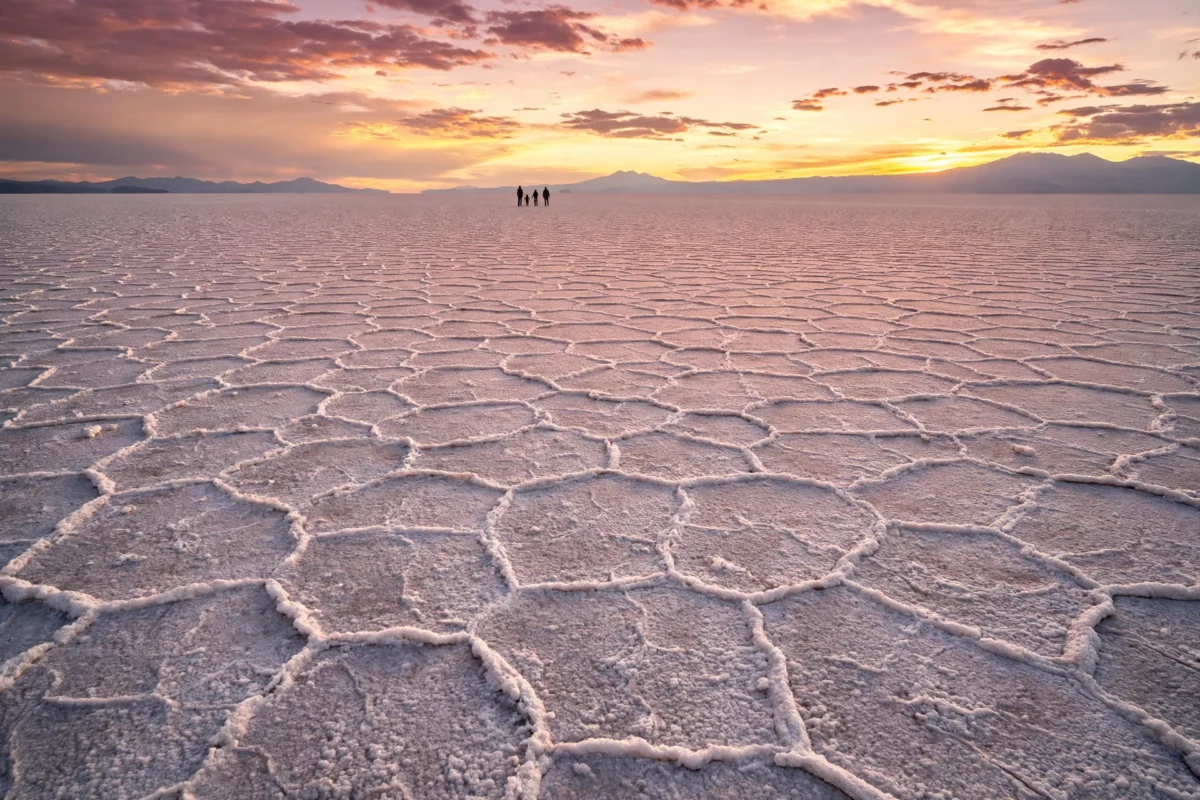
Watching your children run across the endless white horizon of the world’s largest salt flat is a travel moment a family never forgets. Salar de Uyuni is magical for kids: space to run, a giant natural mirror in the rainy season, flamingos to spot and trick photographs to invent. But it is also a remote, high-altitude desert with strong sun, cold nights and long drives. With the right tour format, a realistic pace and a well-packed bag, it can be a wonderful family trip. This guide explains how to do it well in 2026.
Key takeaways
- Uyuni town sits at about 3,656 m (12,000 ft), so altitude — not distance — is the main challenge for children.
- For most families, a private 1-day tour is the sweet spot: flexible stops, early returns and space for naps and snacks.
- Children under 5 can enjoy a short, private visit; the classic 3-day expedition suits confident kids roughly 8 and older.
- Talk to your pediatrician before the trip about altitude and your child’s health.
- Pack for four seasons in one day: fierce sun at noon, freezing wind by sunset.
Is Salar de Uyuni suitable for children? An honest answer by age
The short answer is yes — with conditions. Uyuni is not a theme park: there are no fences, no playgrounds and no quick way back to town once you are out on the salt. What it offers instead is space, silence and wonder. In the wet season (roughly January to March) the mirror effect turns the flat into a giant shallow lake kids can splash across in rain boots.
Babies and toddlers (0–2). A short private outing is possible, but this is the hardest age: you will carry your child almost everywhere, the sun reflects brutally off the salt, and altitude affects small bodies quickly. Many families wait, or keep it to a short sunset trip.
Preschoolers (3–5). A private 1-day tour works if it is built around them: a late start, a long lunch stop, time to play on the salt and an early return. Avoid shared tours and the 3-day expedition, whose long driving days are tough at this age.
School-age children (6–11). This is where Uyuni shines. Kids this age understand the mirror, love the perspective-photo games, can handle a full day on the flat and are fascinated by Incahuasi Island’s giant cacti. A private 1-day tour is ideal; a 3-day tour suits adventurous children who travel well in cars.
Teenagers (12+) can do everything adults can, including the full 3-day route — as long as altitude is respected.
Altitude and kids: what parents really need to know
Uyuni is high. The town sits at roughly 3,656 m, the salt flat at about 3,656–3,700 m, and the 3-day expedition climbs far higher — some passes approach 4,900 m. Children are worse than adults at describing what they feel at altitude, so parents must watch for them: unusual tiredness, headache, nausea, loss of appetite, irritability or disturbed sleep are signs to slow down, descend if symptoms worsen, and seek local medical help if you are worried.
The most effective precaution is time. Do not arrive and tour the same day: give the family at least one easy day in Uyuni town first, with light food, plenty of water and an early night. Our guide to altitude sickness in Uyuni explains symptoms and facilities in depth, and families crossing from Peru will find the same principles in this guide to altitude sickness in Cusco and Machu Picchu.
Important: this article is general educational information, not medical advice. Before traveling to high altitude with children, consult your pediatrician, especially if your child has asthma, heart or lung conditions, or has reacted badly to altitude before. Do not give altitude medication to a child based on a travel blog. Reputable agencies carry oxygen on longer tours as emergency support, and family travel insurance covering high-altitude activities and medical evacuation is strongly worth having — see the best travel insurance options for South America in 2026.
Private vs shared tours: the family decision that matters most
Almost every Uyuni tour runs in a 4×4 with a driver-guide. In a shared tour you split that vehicle with four to six other travelers: it is the cheapest option, but the group sets the pace and there is no turning back early because one child is cold, tired or carsick. In a private tour the vehicle is yours: you choose the start time, linger where the kids are happy, and head back the moment the day has been long enough. For families — above all with children under 8 — the private format is worth every extra dollar.
Before booking, ask: Is a child seat available? Is oxygen carried? How flexible is the return time? Our breakdown of Salar de Uyuni tours compared walks through the formats side by side.
1 day or 3 days with kids? Comparing your real options
The 1-day tour covers the classics in about eight to ten hours: the train cemetery, the salt village of Colchani, lunch on the flat, Incahuasi Island and sunset over the salt. It returns to Uyuni town the same evening — to a proper hotel, a hot shower and a familiar bed. For most families this is the right size of adventure.
The 3-day expedition adds the Eduardo Avaroa Reserve: flamingo-filled lagoons, geysers, hot springs and the Salvador Dalí desert. It is spectacular, but it means long days of driving on rough tracks, nights in basic lodgings and altitudes near 4,900 m. With children under 8, we recommend the 1-day format. Still deciding? Read how many days in Uyuni you really need.
| Option | Best for | Pace & flexibility | Sleeping | Rough 2026 price range* |
|---|---|---|---|---|
| Shared 1-day tour | Budget travelers; families with teens | Fixed group schedule, no early return | Your hotel in Uyuni town | From about US$30–50 per person |
| Private 1-day tour | Most families, especially kids under 8 | Your schedule, your stops, early return possible | Your hotel in Uyuni town (or a salt hotel) | From about US$150–250 per vehicle |
| Private 3-day expedition | Adventurous families with kids 8+ | Flexible-ish, but long fixed driving days | Basic refuges or upgraded reserve hotels | From about US$600–900 per vehicle, more with upgraded lodging |
*Indicative ranges only — prices vary by season and operator; confirm what is included before paying.
Surviving the long drives: warmth, boredom and carsickness
Even a 1-day tour involves hours in the 4×4. Dress children in layers for a day that swings from sunny noon to a freezing sunset: thermal base layer, fleece, insulated jacket, warm hat and gloves. Bring more snacks and water than you think you need; there are no shops once you leave Colchani.
Download audiobooks, music and a film or two before leaving town — there is no signal across most of the route. If your child gets carsick, tell the agency in advance and ask for the front or middle seats. Wet wipes, a change of clothes in a dry bag and plastic bags are unglamorous and essential — in the wet season the mirror means wet feet, and spare socks are gold.
Perspective photos: the part your kids will talk about for years
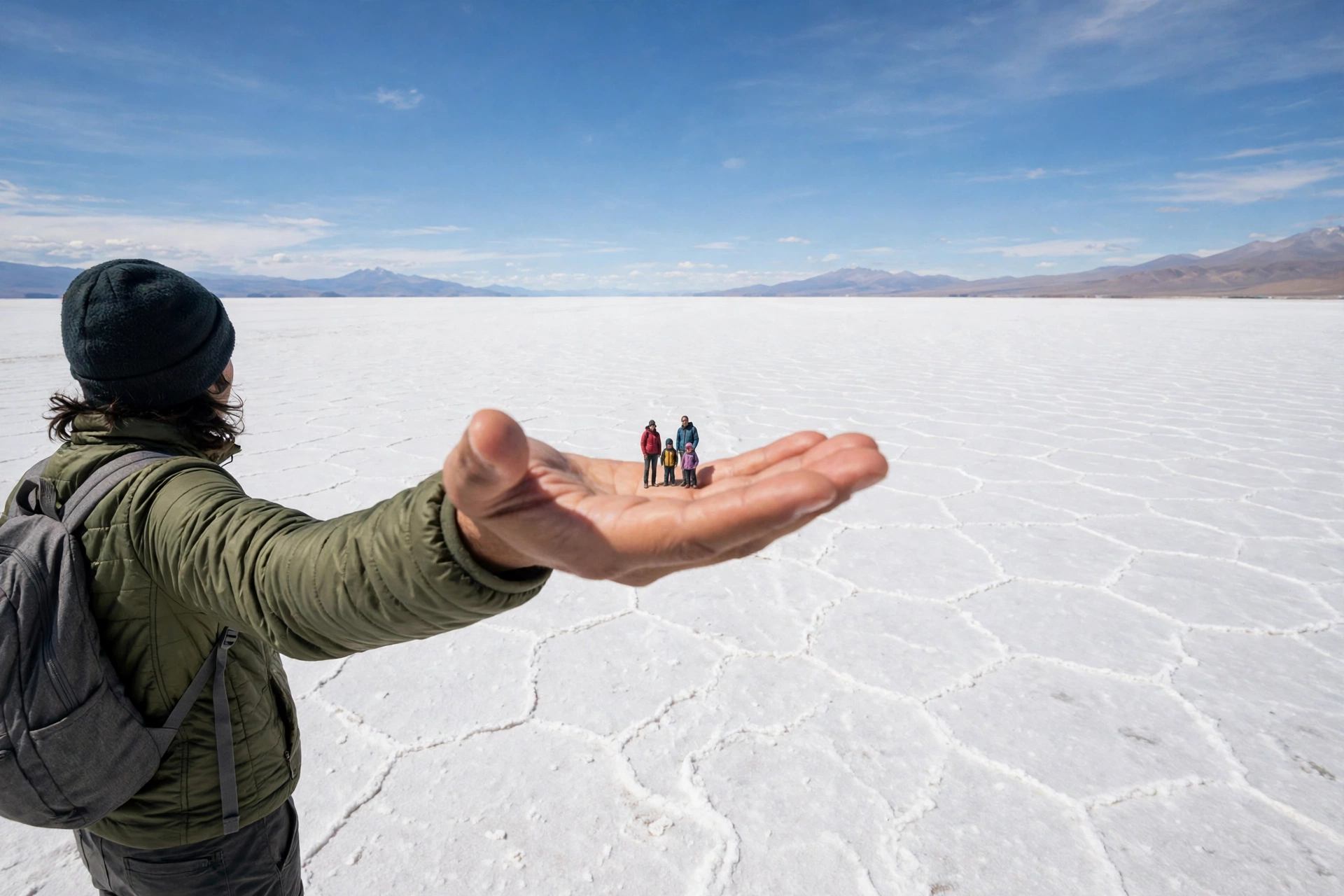
Uyuni’s endless white horizon erases depth, which is why the famous trick photos work: a child “standing” on a parent’s hand, the whole family “escaping” from a toy dinosaur, a tiny traveler “inside” a cooking pot. Bring two or three small props from home and let the kids invent their own scenes; it is the cheapest, happiest hour of the trip. In the wet season, swap props for reflections: the mirror makes families appear to walk on the sky itself. Either way, the reflected glare is intense, so sunglasses and high-SPF sunscreen are not optional.
Sleeping in a salt hotel with your family
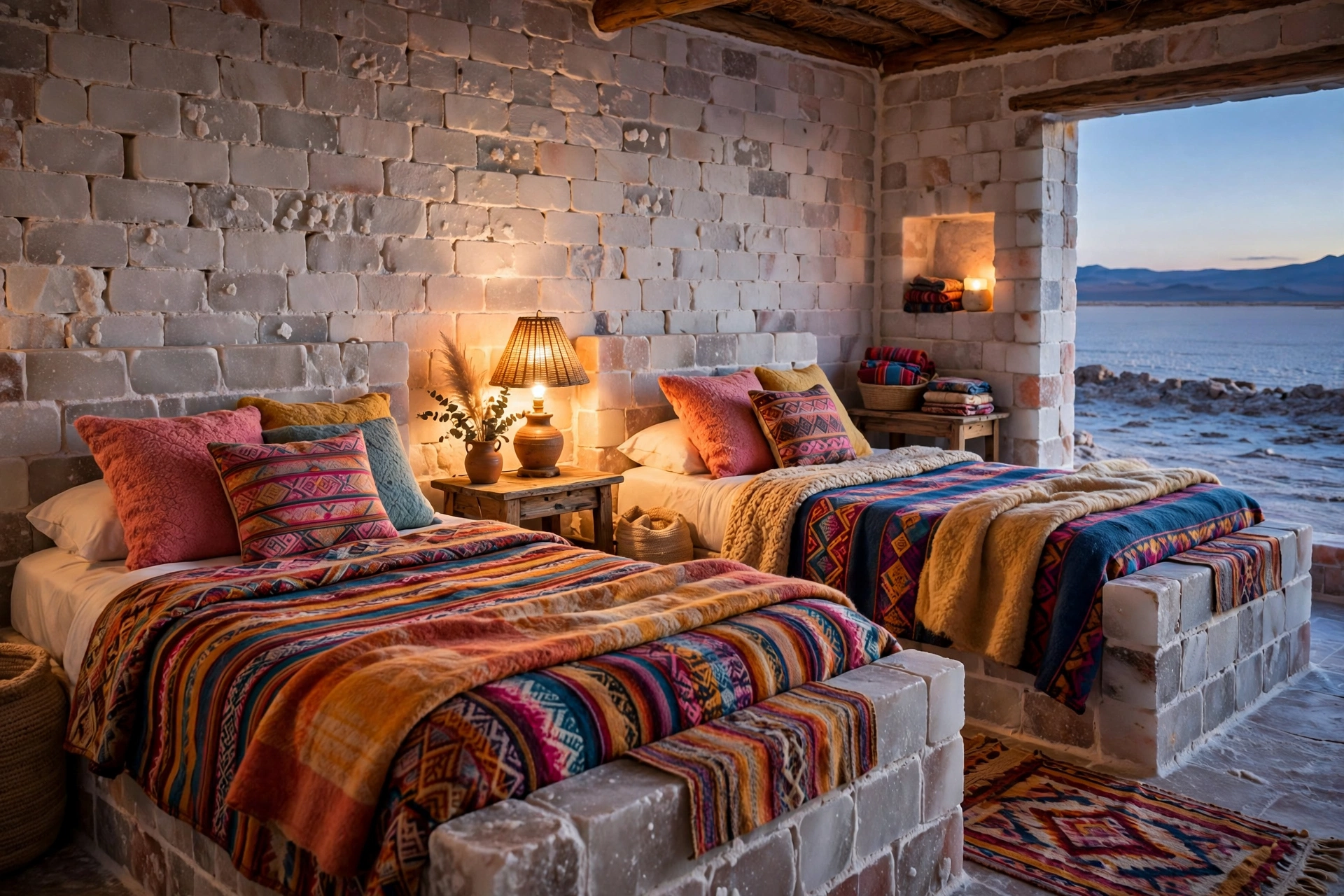
Around Colchani, hotels built largely from salt blocks — walls, bed frames, even tables — turn the night itself into an adventure for kids, and waking up on the edge of the white desert is unforgettable.
Two honest warnings: salt hotels sit outside Uyuni town, so evenings are quiet (bring entertainment with you), and standards vary widely, so check recent reviews for heating and hot water, because nights are cold year-round.
Food, bathrooms and other unglamorous realities
Tour lunches on the flat are simple and filling — grilled meat or chicken, rice and salad, with a vegetarian option if requested in advance. For picky eaters, pack a backup lunchbox with food your child definitely eats.
Bathrooms require a plan: basic facilities exist at Colchani and on Incahuasi Island (usually for a small fee), with long stretches of nothing in between. A travel potty for toddlers, tissues and hand sanitizer prevent most dramas. Carry small Boliviano notes for fees and snacks — card machines are unreliable outside town.
Packing checklist for children in Uyuni
Our full guide to what to pack for Salar de Uyuni covers adults; here is the child-specific version:
- Sun protection: high-SPF sunscreen, lip balm with SPF, sunglasses with a strap, wide-brim hat — the reflection doubles exposure.
- Warm layers: thermal base layer, fleece, insulated windproof jacket, warm hat, gloves and thick socks.
- Footwear: closed walking shoes; in the wet season, rain boots for the mirror and spare socks.
- Health kit (as advised by your pediatrician): regular medication, rehydration salts, plasters, and something for carsickness if your doctor recommends it.
- Food and drink: refillable water bottles, familiar snacks, a backup lunchbox for picky eaters.
- Comfort and entertainment: downloaded audiobooks and films, notebook, stickers, a soft toy for the hotel, and photo props.
- Practical extras: wet wipes, tissues, hand sanitizer, plastic bags, a change of clothes in a dry bag, small cash, and copies of passports and insurance.
Plan your trip
Most families reach Uyuni via La Paz, by domestic flight or tourist bus. Compare flight options into Bolivia on Skyscanner. For guided experiences across Bolivia and South America that you can book ahead, browse Civitatis. And because Uyuni is remote and high, arrange family travel insurance that explicitly covers altitude and medical evacuation before you go; compare policies at SafetyWing.
PLAN YOUR SALAR DE UYUNI TRIP
Book the tour, the hotel and the cover in one go
Frequently asked questions
What is the best age for a child to visit Salar de Uyuni?
There is no official minimum age, but the easiest ages are 6 and up, when children can enjoy a full day and say how they feel at altitude. Younger children can visit on short, private tours built around them; many families wait until age 4–5.
Is the altitude in Uyuni dangerous for children?
Uyuni sits around 3,656 m, so altitude sickness is a real possibility for children and adults alike. Most families who ascend gradually, rest the first day and watch for symptoms do fine. This is general information only — always consult your pediatrician first, and seek local medical care promptly if symptoms appear or worsen.
Should we choose a private or a shared tour with kids?
Private, if your budget allows. You control the start time, stops and return, with space for snacks, layers and naps. Shared tours are cheaper but follow the group’s schedule, which rarely matches a young child’s rhythm.
Is the 3-day Uyuni expedition suitable for young children?
For most children under 8, no: very long driving days, basic high-altitude lodgings and passes near 4,900 m. Confident kids of 8 and older can enjoy it on a private tour with upgraded lodging.
When is the best time to visit Uyuni with kids?
For the mirror effect, the rainy season (roughly January to March) is magical but involves water on the flat and sometimes disrupted routes. For easier driving and classic perspective photos, the dry season (May to October) is more predictable — but colder at night.
What should my child wear on the salt flat?
Layers: a thermal base, fleece and an insulated windproof jacket, plus a warm hat and gloves. Add sunglasses, a sun hat and high-SPF sunscreen for the reflected glare, and rain boots in the wet season.
Are there bathrooms during the Uyuni tour?
Only at a few points — Colchani and Incahuasi Island, usually basic and for a small fee — with long stretches in between. Use every stop, and bring tissues and, for toddlers, a travel potty.
What will my children eat on the tour?
Tour lunches are simple — typically meat or chicken with rice and salad — and vegetarian options can usually be arranged in advance. For picky eaters, pack a backup lunchbox; there are no shops on the flat.
Can we stay in a salt hotel as a family?
Yes. Salt hotels near Colchani offer family rooms and are a highlight for children. Check recent reviews for heating and hot water, which vary a lot, and remember evenings there are quiet — bring books and downloaded entertainment.
How many days do we need in Uyuni with kids?
Plan at least two nights: one easy arrival day to adjust to altitude, then your tour day. Add a third night for the 3-day expedition, or as a spare day in case of tired children or bad weather.